

Bulk Tent Sourcing Checklist: 9 Things to Confirm Before Placing an Order
Planning to buy tents in bulk for your business, retail store, events, or private-label brand? Before placing an order, you need to confirm more than the unit price.
A successful bulk tent sourcing project starts with clear product specifications, realistic order quantities, sample approval, quality requirements, and a complete cost breakdown.
This checklist explains what to confirm before requesting a quotation or choosing a tent supplier. Use it to compare offers, reduce avoidable misunderstandings, and prepare a more accurate purchasing request.
Need help with your next tent order? Contact Sylvanor with your target product, estimated quantity, destination country, and customization requirements.
Quick Answer: What Should You Check Before Buying Tents in Bulk?
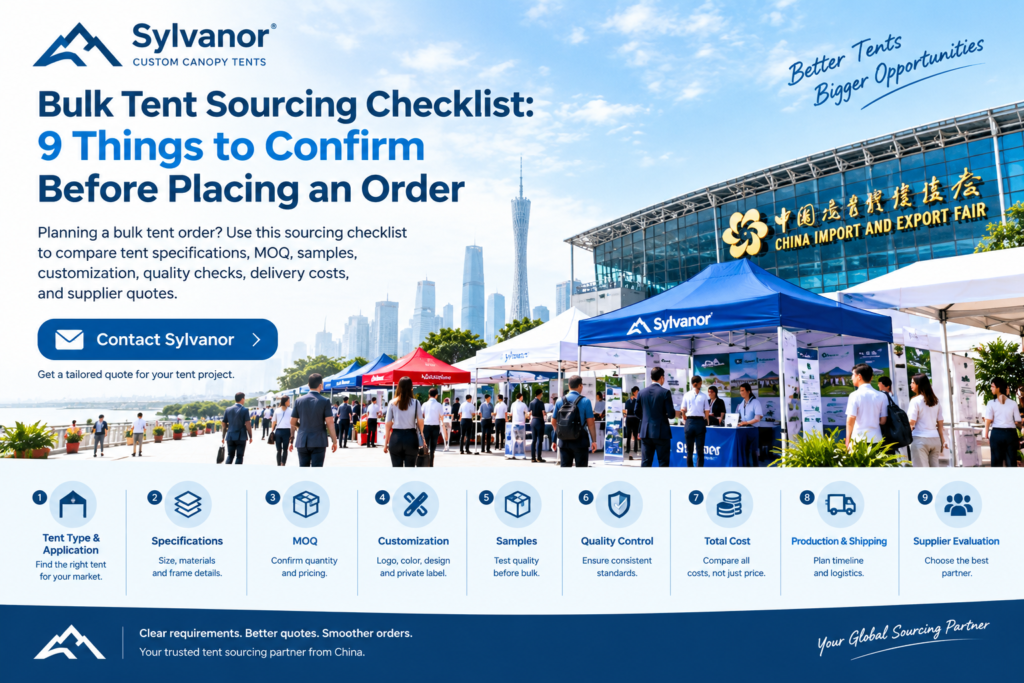
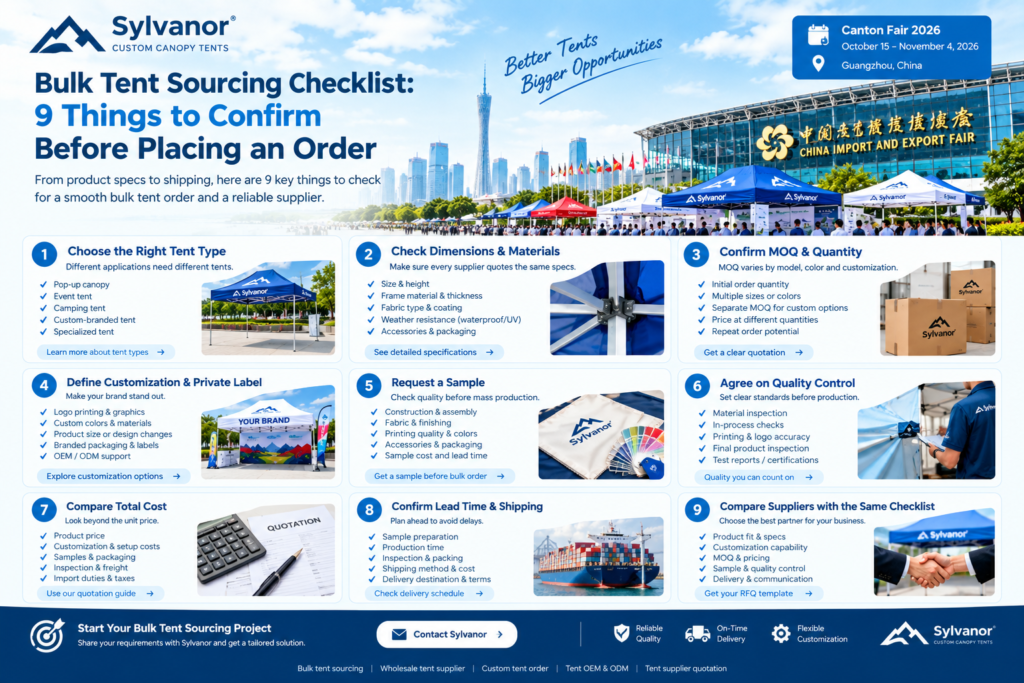
Before placing a bulk tent order, confirm these nine points:
- Tent type and intended application
- Dimensions, materials, and frame specifications
- Minimum order quantity (MOQ)
- Customization and private-label options
- Sample availability and approval process
- Quality inspection requirements
- Total landed cost, not just unit price
- Production lead time and shipping arrangements
- Supplier communication and quotation details
The key rule is simple: compare suppliers using the same specifications. Otherwise, two quotations may look similar while covering different products, materials, packaging, or services.
1. Choose the Right Tent Type for Your Market
Start by defining what the tent needs to do. Different applications require different designs, materials, structures, and purchasing considerations.
| Tent type | Common applications | What to clarify |
|---|---|---|
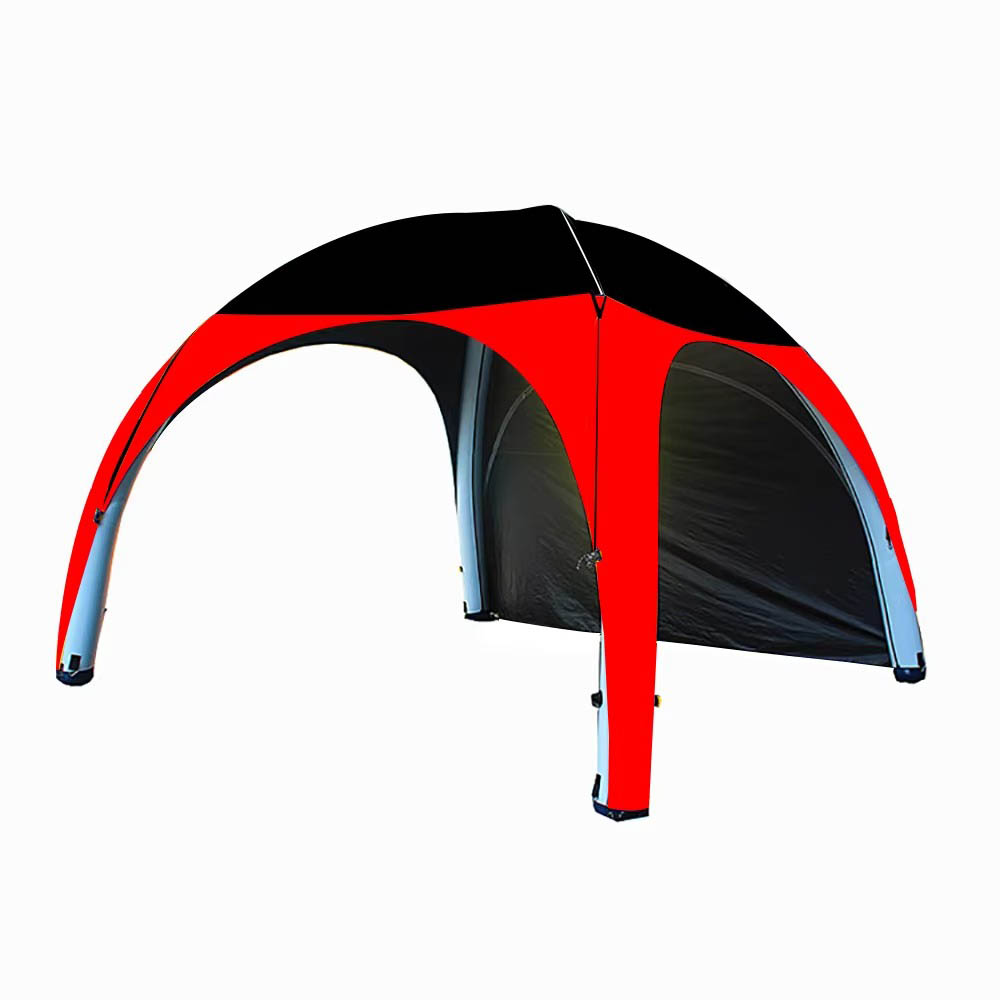
| Pop-up canopy tent | Promotions, outdoor events, temporary brand activations | Setup method, frame, canopy size, printed graphics |
| Event tent | Exhibitions, gatherings, commercial events | Capacity, layout, anchoring, intended use |
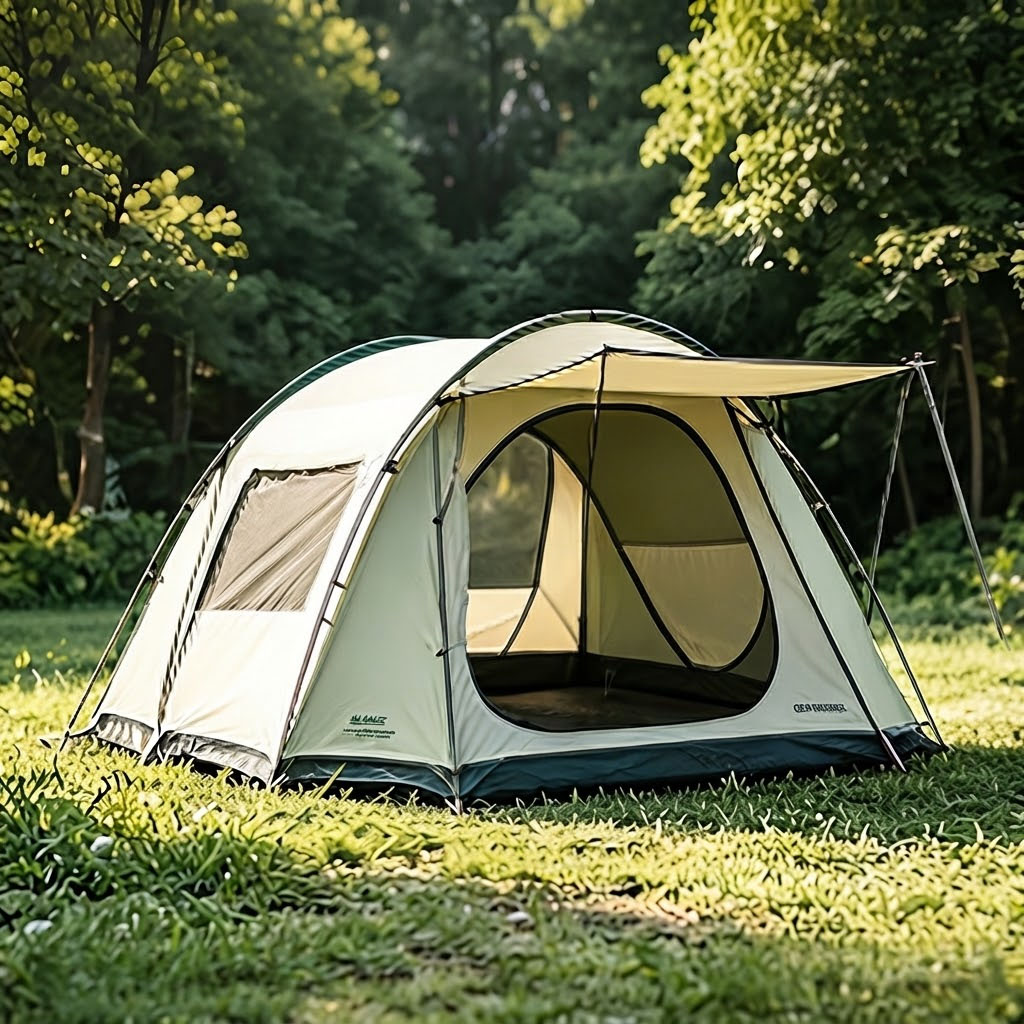
| Camping tent | Outdoor retail, camping brands, distributors | Capacity, seasonality, packed size, fabric and waterproofing requirements |
| Custom-branded tent | Marketing campaigns, retail promotions, private-label products | Logo placement, artwork, color, packaging |
| Specialized tent | Project-specific or commercial applications | Drawings, site conditions, applicable safety requirements |
These categories can overlap. For example, a pop-up canopy may also be a custom-branded promotional product.
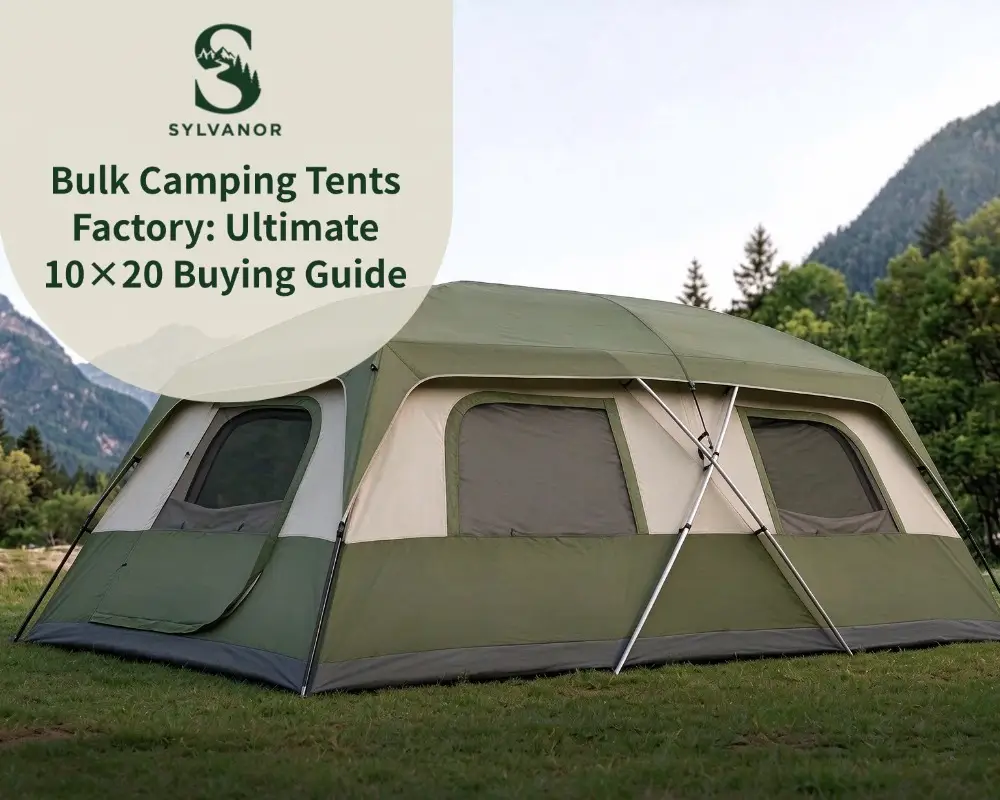
If you are sourcing a specific format, review our bulk camping tent buying guide or explore our guide to custom portable canopy manufacturers.
Buyer tip: Describe the intended application before asking for a quotation. A supplier can give you a more relevant proposal when the use case is clear.
2. Confirm the Size, Frame, and Fabric
Product specifications directly affect pricing, packing, transportation, and the suitability of the final product.
Avoid describing a product only as a “high-quality tent.” Instead, prepare a specification sheet that identifies the requirements that matter to your project.
| Specification | What to confirm |
|---|---|
| Dimensions | Overall size, footprint, height, and usable space |
| Frame | Material, tube dimensions, connection design, and finish |
| Fabric | Material composition, thickness or weight, coating, and color |
| Weather resistance | Required waterproofing, UV resistance, and intended operating conditions |
| Printing | Logo location, print method, artwork, and color requirements |
| Accessories | Sidewalls, ropes, stakes, carrying bags, connectors, or other components |
| Packaging | Individual packaging, carton dimensions, labels, and shipping marks |
Not every project needs every specification. The important step is to identify the requirements that affect your product’s intended use.
For example, a branded promotional canopy may prioritize appearance, portability, and setup. A camping tent may require more detailed information about capacity, packed size, weather conditions, and fabric performance.
Do not rely on general descriptions such as “waterproof,” “heavy-duty,” or “wind-resistant” without defining the required performance and how it will be checked.
3. Confirm the MOQ Before Negotiating the Unit Price
MOQ means minimum order quantity. It may vary depending on the tent model, material, color, printing requirements, packaging, and production arrangement.
When requesting a quotation, ask for pricing at the quantities you are actually considering.
For example:
- Sample or prototype quantity
- Initial trial order
- Planned standard order
- Potential repeat-order quantity
Ask the supplier whether the MOQ applies to each model, size, color, or design, or whether different options can be combined.
If you are testing a new market, a smaller initial order may help you evaluate product quality and customer demand. However, the supplier may quote a different unit price for a smaller quantity.
Ask these questions:
- What is the MOQ for the selected model?
- Is there a separate MOQ for custom colors or printed logos?
- Can multiple sizes or designs be combined in one order?
- Does the quoted price change at different order quantities?
Confirm these details before comparing prices or committing to a purchasing plan.
4. Define Customization and Private-Label Requirements
If you are developing your own brand or supplying a customer with a specific design, clarify the customization scope before production.
Depending on the product and supplier’s capabilities, requirements may include:
- Logo printing or custom graphics
- Fabric color and material selection
- Product dimensions or design adjustments
- Private-label packaging
- Product labels, manuals, or inserts
- Customized accessories
Not every supplier offers every option. Ask which requirements can be supported for your selected model and which may require additional tooling, setup, or development time.
For custom projects, prepare your logo files, reference images, dimensions, packaging requirements, and any technical drawings before requesting a final quotation.
For more specific purchasing considerations, see our guide to requesting a custom canopy tent quote.
Important: Confirm the final artwork, specifications, and packaging details in writing before approving mass production.
5. Request a Sample Before Approving a Large Order
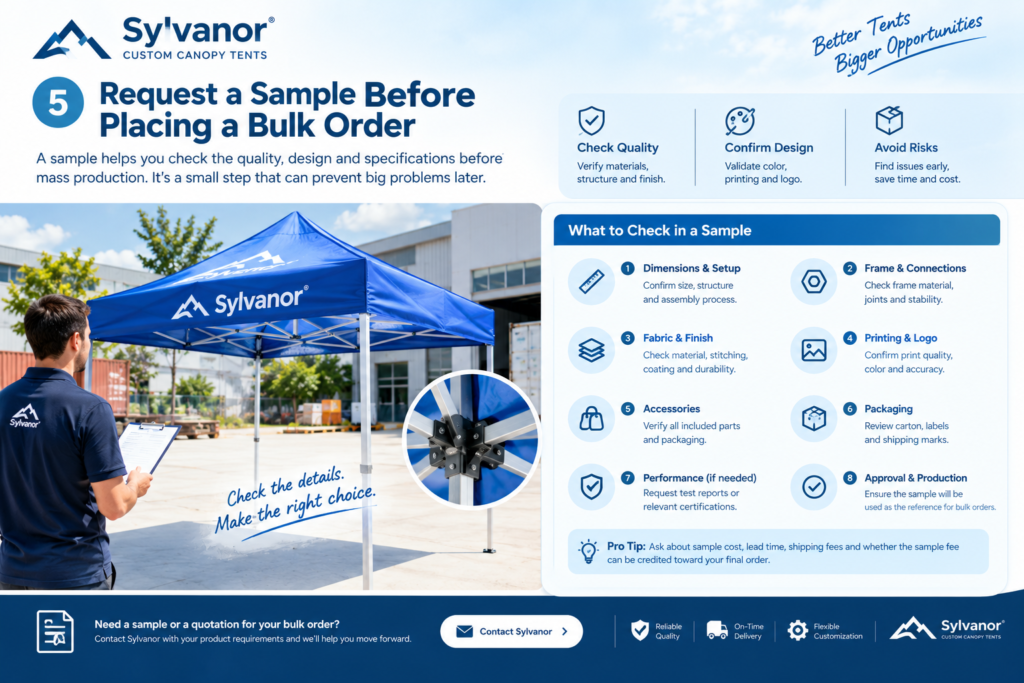
A sample helps you assess whether the proposed product matches your expectations before committing to a larger quantity.
Where a sample is available, check the product against your agreed requirements.
Review:
- Dimensions and overall construction
- Frame connections and assembly
- Fabric appearance, stitching, and finishing
- Printing quality and logo placement
- Included accessories
- Packaging and instructions
- Any agreed product performance requirements
For custom products, make sure the sample reflects the intended materials, colors, graphics, and key specifications as closely as possible.
Ask the supplier to confirm whether the approved sample will serve as the reference for bulk production. Also clarify sample costs, shipping fees, production time, and whether any sample fee can be credited toward a future order.
Do not approve a sample based on appearance alone. Check the specifications that matter to your intended use and record any required changes before production begins.
6. Agree on Quality Checks Before Production
Quality requirements should be agreed upon before the order is confirmed, not after the goods are ready to ship.
The inspection plan should match the product and the risks associated with its intended use.
For example, you may need to check:
- Product dimensions and material specifications
- Stitching, seams, finishing, and visible defects
- Frame assembly and component fit
- Logo accuracy and color consistency
- Accessory quantities
- Packaging, labels, and carton markings
- Any agreed performance or safety requirements
For projects with specific technical or regulatory requirements, identify the applicable standards and the documents needed to demonstrate compliance. Do not assume that a general supplier statement proves compliance with every requirement in your destination market.
Before production, clarify who will conduct the inspection, when it will take place, what will be checked, and how defects or nonconforming goods will be handled.
Put the agreed acceptance criteria in writing.
7. Compare the Total Cost, Not Just the Unit Price
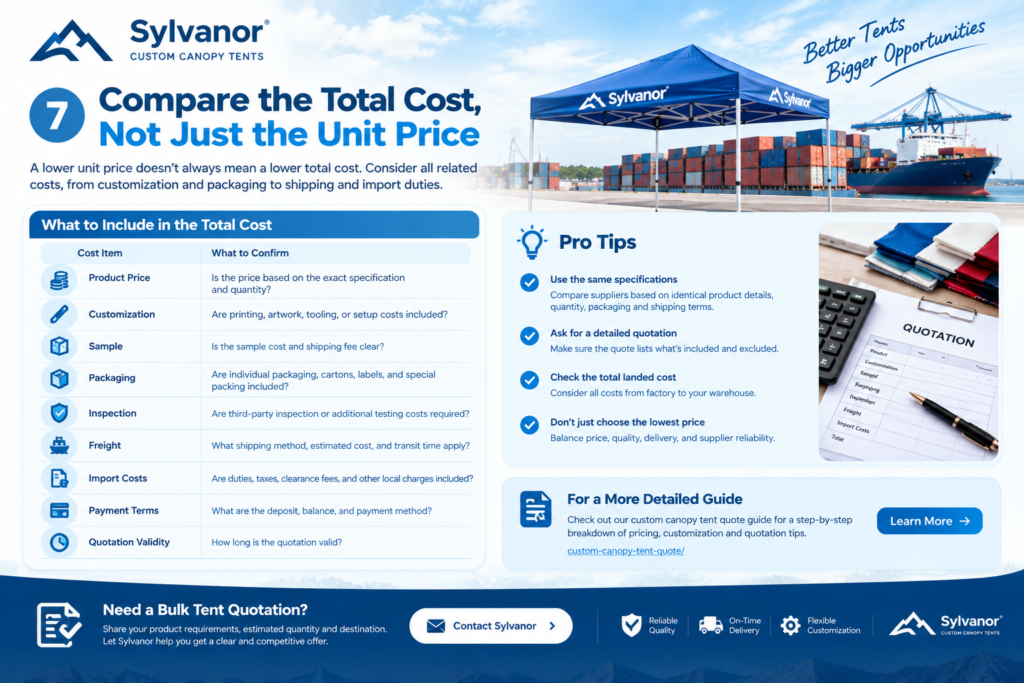
A lower unit price does not always mean a lower overall purchasing cost.
Your final cost may include the product, customization, packaging, samples, inspection, freight, insurance, import duties, taxes, and other destination-related charges.
| Cost item | What to confirm |
|---|---|
| Product price | Unit price and included components |
| Customization | Printing, special materials, or design-related charges |
| Sample | Sample cost and delivery fee |
| Packaging | Individual packaging, cartons, labels, and special packing |
| Inspection | Whether third-party or additional checks are required |
| Freight | Shipping method, estimated cost, and transit time |
| Import costs | Applicable duties, taxes, and clearance fees |
| Payment terms | Deposit, balance, payment method, and due dates |
Not every quotation will include all these items. Ask suppliers to identify what is included and excluded.
When comparing offers, make sure they use the same product specifications, order quantity, packaging assumptions, delivery destination, and shipping terms.
If you are comparing shipping arrangements, confirm the applicable Incoterm and named place or port. This helps clarify which party is responsible for different costs and responsibilities.
A useful rule: Compare the estimated total cost under the same assumptions before selecting a supplier.
8. Confirm Production Lead Time and Shipping
Your delivery plan should account for more than the time needed to manufacture the tents.
Confirm the expected timeline for:
- Sample preparation and approval
- Artwork and specification confirmation
- Material preparation
- Mass production
- Quality inspection
- Packing and dispatch
- International transportation and import clearance
Ask when the production lead time begins. For customized orders, it may start only after the supplier receives the required deposit, approved sample, artwork, or final specifications.
You should also confirm how the goods will be packed and shipped. Tent frames and fabric can have different packing requirements, so carton dimensions and shipment volume may affect the freight quotation.
If you have a fixed launch date, exhibition, seasonal sales period, or project deadline, share it before confirming the order.
Buyer tip: Ask the supplier to identify the expected completion date, shipping assumptions, and any factors that could delay delivery. Treat estimates as estimates until the relevant arrangements are confirmed.
9. Compare Tent Suppliers With the Same Checklist
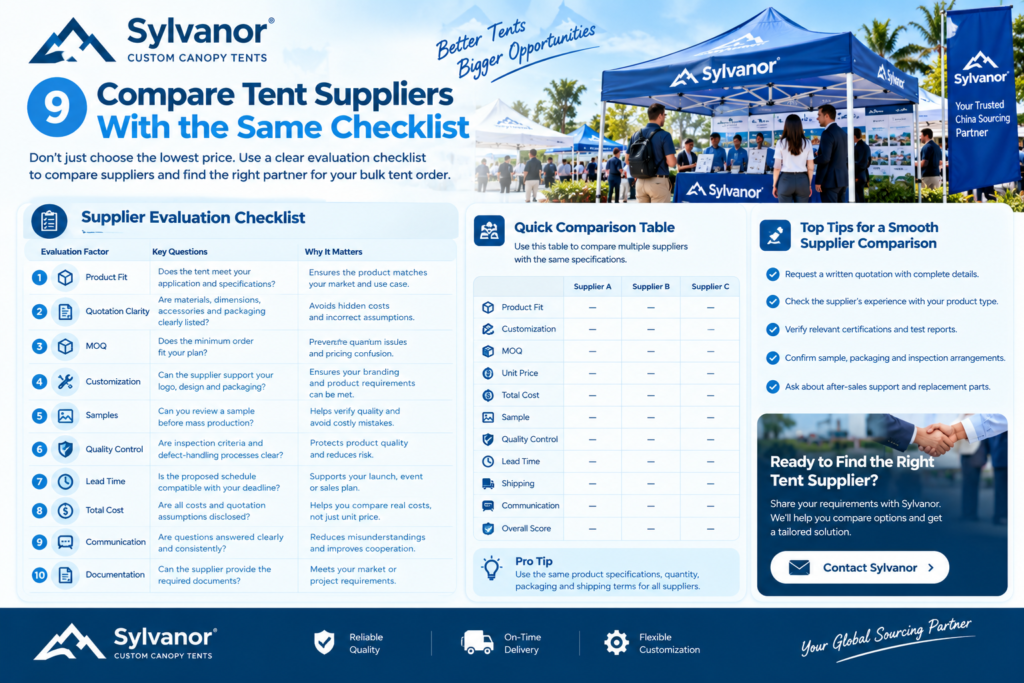
Once you receive multiple quotations, evaluate the details rather than choosing based on price alone.
Use the checklist below to compare suppliers consistently.
| Evaluation point | Questions to ask |
|---|---|
| Product fit | Does the proposed tent meet your intended application and specifications? |
| Quotation clarity | Are materials, dimensions, accessories, and packaging clearly listed? |
| MOQ | Does the minimum quantity fit your purchasing plan? |
| Customization | Can the supplier support the required logo, design, and packaging? |
| Samples | Can you review a sample before approving production? |
| Quality control | Are the inspection criteria and defect-handling process clear? |
| Lead time | Is the proposed schedule compatible with your deadline? |
| Total cost | Are included and excluded charges clearly identified? |
| Communication | Does the supplier answer technical and commercial questions clearly? |
| Documentation | Can the supplier provide the documents your project or market requires? |
Before placing an order, request a written quotation and make sure it matches the latest approved specifications.
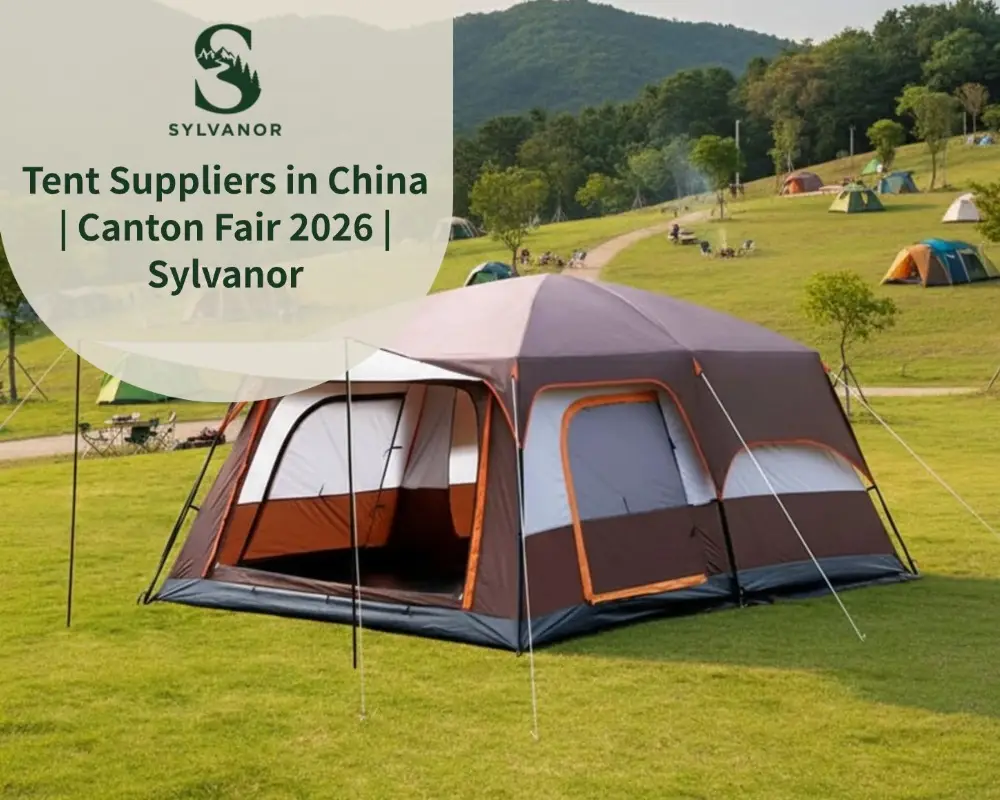
You can also review our guide to tent suppliers in China and the Canton Fair for additional sourcing considerations.
Copy-and-Paste RFQ Template for Bulk Tent Orders
Use the template below when contacting potential suppliers. Replace the bracketed fields with your project details.
Subject: RFQ – Bulk Tent Order for [Company Name]
Hello,
We are looking for a supplier for a bulk tent order and would like to request a quotation.
Please review our initial requirements below.
- Tent type: [Pop-up canopy / camping tent / event tent / other]
- Intended application: [Retail / events / camping / project use / other]
- Dimensions: [Required size]
- Estimated quantity: [Quantity]
- Frame requirements: [Material or specifications, if known]
- Fabric requirements: [Material, color, or performance requirements]
- Customization: [Logo / custom color / private label / packaging]
- Accessories: [Required items]
- Sample required: [Yes / No]
- Destination country: [Country]
- Target delivery date: [Date]
- Required documents or standards: [If applicable]
Please confirm:
- Product availability and relevant specifications
- MOQ and unit price at our estimated quantity
- Sample availability, cost, and lead time
- Customization options and related costs
- Production lead time
- Packaging details
- Shipping options and quotation assumptions
- Applicable product documents and quality inspection options
- Payment terms and quotation validity
Please also identify any requirements that need further clarification before you can provide a final quotation.
Thank you. We look forward to reviewing your proposal.
Best regards,
[Name]
[Company]
[Email / WhatsApp]
How Sylvanor Can Help With Your Tent Sourcing Project
Choosing the right tent is only one part of a successful purchasing project. You also need clear specifications, a comparable quotation, and an agreed process for samples, customization, production, and delivery.
Sylvanor can be a starting point for buyers exploring tent and outdoor-product sourcing from China. To help assess whether your requirements are a suitable fit, share the product type, estimated quantity, destination market, and any customization or project requirements.
The more clearly you define your needs, the easier it is to evaluate potential sourcing options.
Ready to discuss your order?
Contact Sylvanor and include your requirements to start the conversation.
Frequently Asked Questions About Bulk Tent Sourcing
What information do I need to request a bulk tent quotation?
At minimum, provide the tent type, dimensions, intended application, estimated quantity, destination country, and customization requirements. Include material specifications, accessories, packaging, and required delivery date when available.
How do I compare quotations from different tent suppliers?
Compare quotations using the same specifications, quantity, customization, packaging, delivery destination, and shipping assumptions. Check what each price includes and excludes before making a decision.
Should I request a sample before placing a bulk tent order?
When practical, yes. A sample lets you review the construction, materials, dimensions, printing, and finishing before approving a larger order. Confirm how the approved sample relates to the final production specifications.
What affects the cost of a custom tent order?
The main factors can include tent size, frame and fabric materials, design complexity, printing, accessories, order quantity, packaging, inspection, shipping, and applicable import costs. The actual impact depends on the product and order requirements.
What should I confirm before mass production starts?
Confirm the final specifications, approved artwork, sample status, quantity, unit price, payment terms, production schedule, inspection criteria, packaging, and delivery arrangements in writing.
Can I order custom-branded tents for my business?
Custom-branded options may include logo printing, selected colors, packaging, or other product changes. Availability depends on the tent model and supplier capabilities, so confirm the options, minimum quantities, costs, and sample requirements before ordering.
How long does bulk tent production take?
Production time varies by product, order quantity, customization, material availability, and the supplier’s production schedule. Ask for a project-specific estimate and confirm when the lead time begins. International shipping and import clearance should be considered separately.
Final Checklist Before You Place Your Order
Before confirming a bulk tent purchase, make sure you have:
- Defined the tent type and intended application
- Confirmed the key dimensions and materials
- Checked the MOQ and quantity-based pricing
- Agreed on customization and packaging
- Reviewed the sample or agreed on the approval process
- Written down the quality acceptance criteria
- Compared the total estimated cost
- Confirmed the production and shipping plan
- Received a clear written quotation
A well-prepared sourcing request helps both sides understand the project and reduces avoidable questions during quotation and production.
Planning your next bulk tent order? Contact Sylvanor with your requirements and start with a clearer sourcing brief.