

Canopy Tent RFQ: How to Get an Accurate Quote from a Supplier
You have a canopy tent project.
You send the same message to five suppliers:
“How much for a 10×10 canopy tent?”
Then you receive five completely different prices.
One supplier quotes a bare tent.
Another includes walls.
Another assumes full-color printing.
Another uses a different frame specification.
The problem isn’t the price. The problem is that you’re not comparing the same product.
A supplier cannot accurately quote what has not been clearly defined.
The fastest way to get a useful canopy tent quotation is not to ask for a lower price.
It is to send a better RFQ.
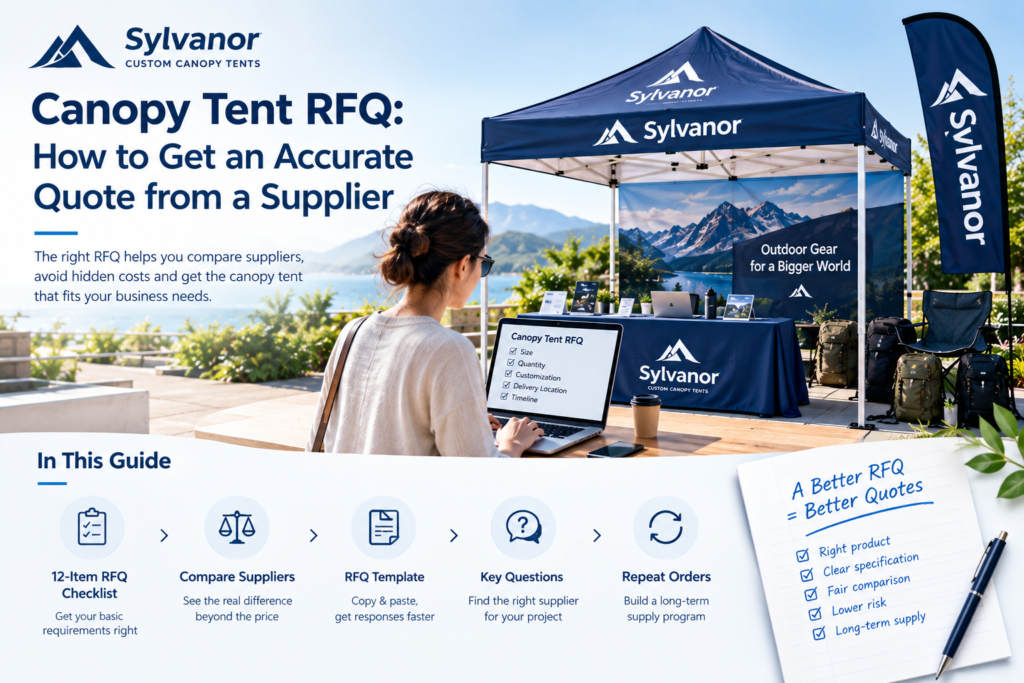
This guide walks you through the buyer journey — from preparing your requirements and comparing suppliers to approving a sample and building a repeatable specification for future orders.
What You’ll Learn in This Guide
- The 12 items to include in a canopy tent RFQ
- How to compare suppliers without relying on headline prices
- What specifications suppliers need before quoting
- What to check when reviewing a sample
- A copy-and-paste RFQ template
- Questions to ask before choosing a supplier
- How to prepare for repeat wholesale orders
Quick Answer: What Should You Include in a Canopy Tent RFQ?
A strong RFQ should give the supplier enough information to understand what you want, how you will use it, how many you need, and where it needs to go.
The 12 key RFQ items
| RFQ Item | What to Provide |
|---|---|
| Application | Trade show, market, sports event, retail, food service, promotion |
| Tent Size | 10×10, 10×15, 10×20, custom |
| Frame | Steel, aluminum, or supplier recommendation |
| Fabric | Required specification or intended use |
| Printing | Logo, full-color graphics, branded canopy, or plain |
| Walls | None, half walls, full walls, doors/windows |
| Accessories | Carry bag, weights, flags, tables, lighting |
| Quantity | Sample quantity + expected bulk quantity |
| Destination | Country, city, or delivery location |
| Artwork | Logo, AI/PDF file, reference design, or mockup |
| Timeline | Sample deadline + bulk delivery target |
| Commercial Terms | Shipping method or Incoterm, if applicable |
You don’t need to have every specification finalized before contacting a supplier.
If you’re unsure about the frame, fabric, or configuration, tell the supplier what you already know and ask them to recommend suitable options.
Need a quote?
Send your requirements to Sylvanor with your application, size, quantity, customization requirements, destination, and target timeline.
1. Start With the Application — Not the Product
Before discussing materials or prices, tell the supplier how the canopy tent will be used.
This is one of the easiest ways to make your RFQ more accurate.
Common applications
- Farmers markets
- Vendor booths
- Trade shows
- Outdoor exhibitions
- Sports events
- Food and beverage promotions
- Retail pop-up stores
- Brand activations
- Community events
- Corporate events
- Rental businesses
- Wholesale distribution
Why does this matter?
Consider two buyers.
Buyer A:
“We need 20 branded tents for three promotional events.”
Buyer B:
“We are a distributor looking for a repeatable 10×10 commercial canopy for wholesale resale.”
Both are looking for a 10×10 canopy tent.
But their requirements are different.
Buyer A may care more about:
- Branding
- Printing
- Event setup
- Delivery timing
Buyer B may care more about:
- Consistent specifications
- Packaging
- Accessories
- Replacement parts
- Repeat orders
Tell your supplier:
“The tents will be used for [application]. Expected quantity is [quantity], and we plan to [one-time purchase / reorder / wholesale distribution].”
This gives the supplier useful commercial context before preparing the quotation.
2. Choose the Tent Size
Common commercial canopy sizes include:
- 10×10 ft
- 10×15 ft
- 10×20 ft
- Custom sizes
If you already know the required size, state it directly.
10×10 ft commercial pop-up canopy tent
If you are not sure which size you need, describe the setup instead.
“We need a tent for two staff members, one product display table, and a branded back wall. Please recommend a suitable size.”
This can be more useful than choosing a size before considering the actual layout.
Also confirm:
- Open footprint
- Usable interior space
- Overall height
- Leg height
- Peak height
- Whether the quoted size refers to the frame or finished canopy
The goal
Make sure every supplier is quoting the same size.
3. Specify the Frame
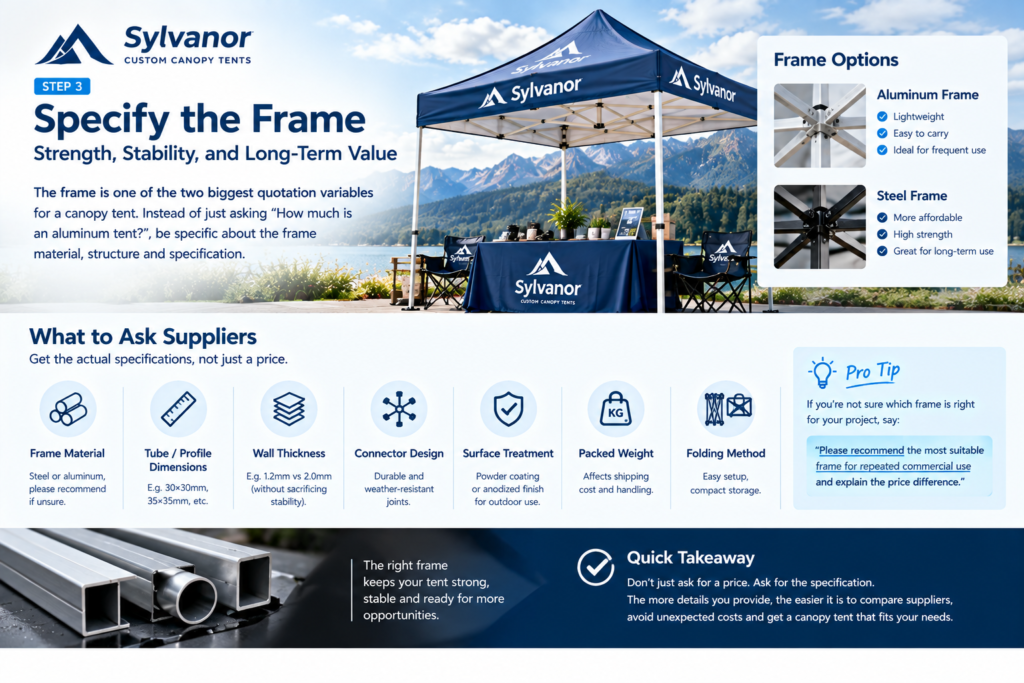
Frame construction is an important quotation variable.
Common options include steel and aluminum.
Steel Frame
Often considered when buyers prioritize:
- Structural strength
- Cost-conscious purchasing
- Commercial applications
The main consideration is that steel can be heavier to transport and handle.
Aluminum Frame
Often considered when buyers prioritize:
- Portability
- Easier handling
- Repeated setup and breakdown
The trade-off is usually a higher product cost compared with basic steel configurations.
Don’t just ask:
“How much is an aluminum tent?”
Ask instead:
“Please quote the tent with an aluminum frame and provide the frame specification.”
This gives you something specific to compare.
Ask suppliers to clarify:
- Frame material
- Frame specification
- Leg structure
- Connector design
- Frame finish
- Surface treatment
- Approximate packed weight
- Folding and storage method
If you are unsure which frame is appropriate, ask:
“Please recommend the most suitable frame for repeated commercial use and explain the price difference.”
4. Define the Fabric Requirements
Fabric affects the appearance, handling, outdoor performance, and printing requirements of the canopy.
Instead of simply asking for:
“Good-quality fabric”
tell the supplier what matters to your application.
Consider:
- Outdoor use
- UV exposure
- Waterproofing requirements
- Branding quality
- Fabric weight
- Cleaning and maintenance
- Frequency of use
- Any specific performance requirements for your market
Example RFQ line
“Please quote the recommended canopy fabric for outdoor commercial use and provide the fabric specification, GSM, coating, and available colors.”
This gives you a clearer basis for comparing suppliers.
5. Decide How Much Branding You Need
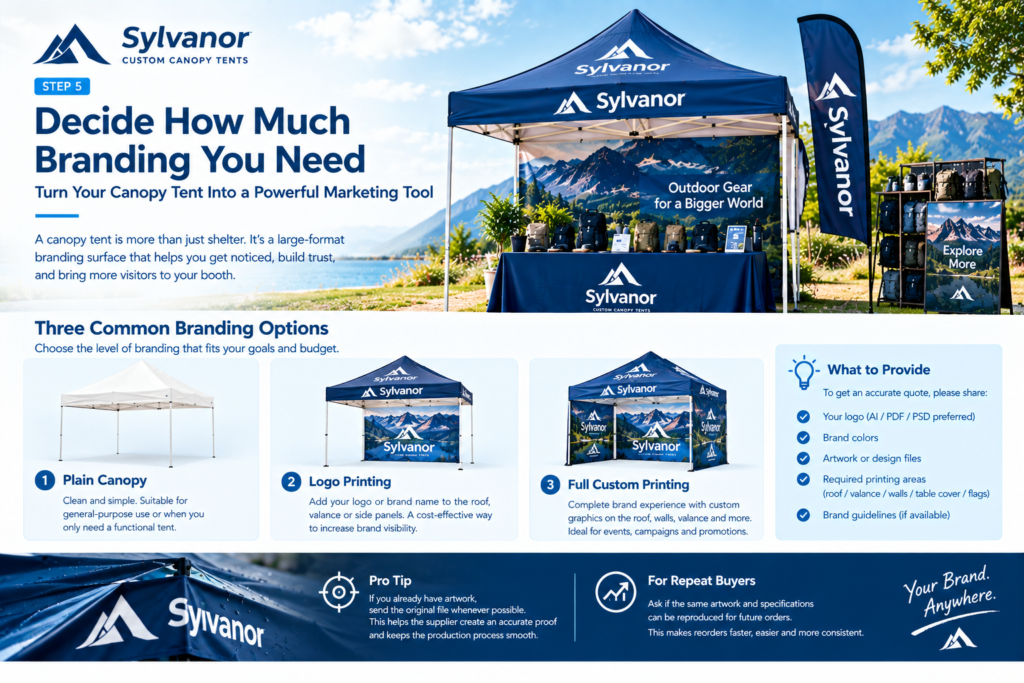
For many commercial buyers, a canopy is more than temporary shelter.
It can also become a large-format branding surface.
There are three common approaches.
| Branding Option | Suitable For |
|---|---|
| Plain Canopy | General-purpose use |
| Logo Printing | Company or event branding |
| Full Custom Printing | Brand identity, campaigns, events, promotions |
When requesting a custom quotation, provide:
- Logo
- Brand colors
- Artwork
- Reference images
- Required printing areas
- Brand guidelines, if available
If you already have artwork
Send the original artwork file whenever possible.
You can write:
“We have attached our logo and artwork. Please confirm whether the file is suitable for production and provide a digital proof before manufacturing.”
For repeat buyers
Ask one additional question:
“Can the same artwork and specifications be reproduced for future orders?”
This can make future reorders much easier.
6. Don’t Forget the Walls
Two suppliers can quote the same “10×10 canopy tent” while offering completely different wall configurations.
Common options include:
- No walls
- Half walls
- Full walls
- Side walls
- Back wall
- Door wall
- Window wall
- Printed walls
Instead of:
10×10 custom canopy tent
Be more specific:
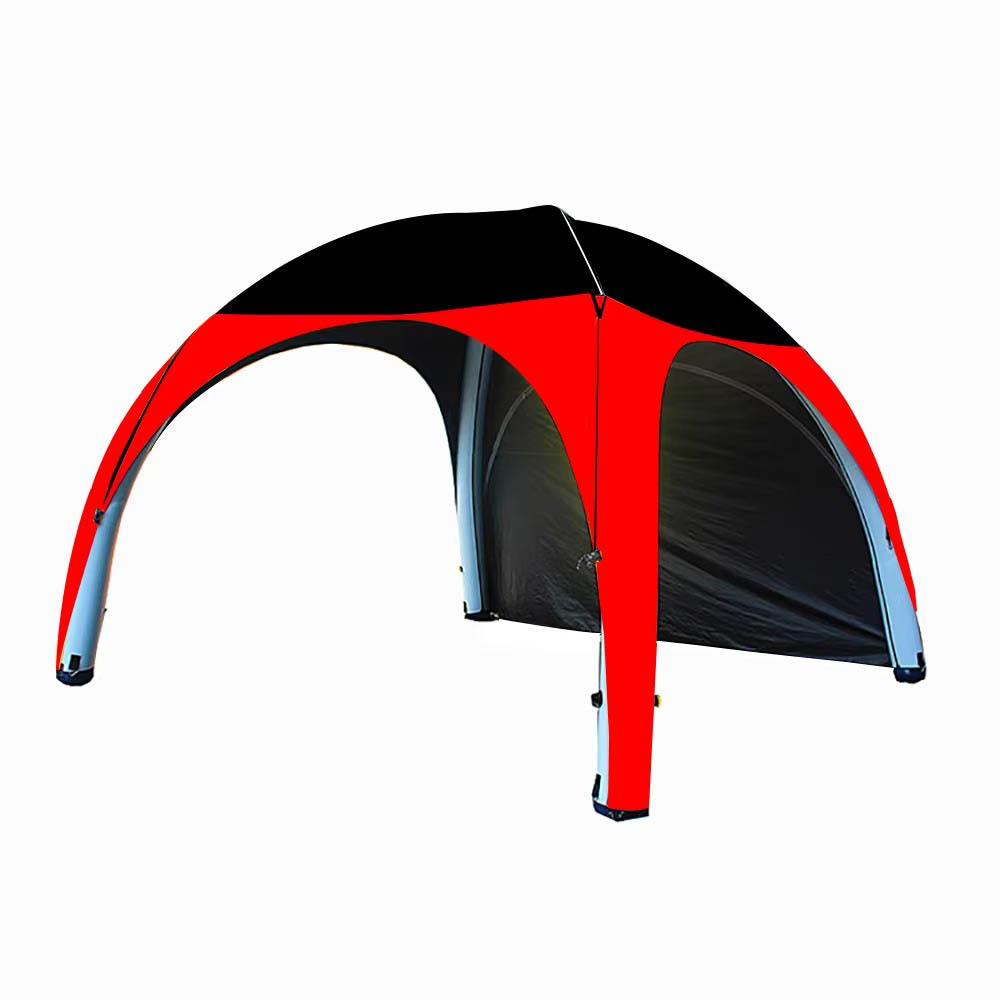
10×10 commercial canopy, full printed top, three full printed walls, one entrance opening.
That single sentence makes the quotation much easier to understand and compare.
7. List the Accessories You Actually Need
Accessories are one of the easiest parts of an RFQ to overlook.
They can also become an unexpected source of additional costs if they are not defined from the beginning.
Depending on your application, you may need:
- Carry bag
- Protective packaging
- Tent weights
- Ground anchoring
- Sidewalls
- Printed walls
- Flags
- Banners
- Table covers
- Tables
- Counters
- Display racks
- Lighting
- Replacement parts
Ask yourself:
Do I need a tent, or do I need a complete event setup?
If you are buying for resale, ask the supplier to quote accessories separately.
Example
| Item | Quantity |
|---|---|
| 10×10 canopy tent | 100 pcs |
| Carry bag | 100 pcs |
| Full walls | 300 pcs |
| Weight set | 100 sets |
| Printed flags | 100 pcs |
This makes the quotation much easier to analyze.
8. Ask for a Line-by-Line Quotation
A low headline price does not automatically mean a lower total purchasing cost.
Ask suppliers to separate the major cost items.
Example quotation comparison
| Cost Item | Supplier A | Supplier B | Supplier C |
|---|---|---|---|
| Tent | $___ | $___ | $___ |
| Printing | $___ | $___ | $___ |
| Walls | $___ | $___ | $___ |
| Accessories | $___ | $___ | $___ |
| Packaging | $___ | $___ | $___ |
| Shipping | $___ | $___ | $___ |
| Total | $___ | $___ | $___ |
This helps you compare the same product, rather than three different headline prices.
9. Confirm Shipping and Delivery Requirements
A canopy tent quotation is incomplete if you don’t know how the goods will reach you.
Tell suppliers:
- Destination country
- Destination city
- Port, warehouse, or delivery location when applicable
- Preferred shipping method
- Required delivery date
- Applicable commercial terms
Example
Destination: Los Angeles, USA
Quantity: 100 sets
Required delivery: [date]
Please quote product price and shipping separately.
When comparing multiple suppliers, ask them to quote under the same delivery conditions.
Otherwise, a lower product price may simply reflect different shipping assumptions.
10. Request a Sample Before a Large Order
If the purchase is significant or you expect repeat orders, a sample can help you verify the actual product before bulk production.
When the sample arrives, don’t just look at the overall appearance.
Use a checklist.
Product
- Frame construction
- Frame operation
- Fabric
- Canopy size
- Wall fit
- Stitching
- Printing
- Accessories
- Carrying and packing method
Branding
- Logo position
- Color appearance
- Artwork proportions
- Printed area
- Overall visual consistency
Packaging
- Individual packaging
- Carton dimensions
- Product protection
- Product identification
The key step
Once the sample is approved, document exactly what was approved.
Record:
- Date
- Product specification
- Artwork
- Accessories
- Packaging
- Any approved changes
This gives you a clear reference for bulk production.
11. Lock the Approved Specification Before Bulk Production
A sample is useful only if the bulk order follows the approved specification.
After approval, create a final product specification.
Example
Product: Custom 10×10 Commercial Canopy
Frame: [approved specification]
Canopy: [approved specification]
Printing: [approved artwork]
Walls: [approved configuration]
Accessories: [approved list]
Packaging: [approved packaging]
Quantity: [bulk quantity]
Then check that the supplier’s:
- Quotation
- Production specification
- Artwork
- Packaging
- Bulk order
all match the approved version.
Why this matters
It turns the approved sample into a repeatable product reference instead of relying on old emails or chat messages.
12. Ask These 10 Questions Before Choosing a Supplier
Before placing an order, ask:
- What frame material and specification are included?
- What fabric specification is included?
- What printing method and options are available?
- Are walls included in the quoted price?
- Which accessories are included?
- What is the MOQ?
- What is the sample cost and sample lead time?
- What is the estimated bulk production lead time?
- What packaging is included?
- Can you provide a complete quotation based on the same specification?
These questions move the conversation from:
“What’s your price?”
to:
“What exactly am I buying?”
That is a much more useful position for a B2B buyer.
13. Manufacturer or Trading Company: What Should You Ask?
Don’t choose a supplier based only on the label “manufacturer” or “trading company.”
Instead, focus on whether the supplier can clearly handle your requirements.
Ask:
- Can you provide the requested specifications?
- Can you customize the product?
- Can you provide samples?
- Can you provide artwork proofs?
- Can you quote the required quantity?
- Can you explain production and packaging?
- Can you support repeat orders?
- Can you communicate clearly throughout the project?
For wholesale buyers, repeatability, specification control, and communication can be just as important as the initial product price.
14. Watch for These Common RFQ Problems
Problem 1: One-Line Pricing
“10×10 tent — $XX”
You still don’t know what is included.
Problem 2: Different Specifications
Supplier A quotes aluminum.
Supplier B quotes steel.
Supplier C quotes a different wall configuration.
Direct price comparison is meaningless.
Problem 3: Accessories Are Unclear
The tent price looks attractive.
Then the carry bag, walls, weights, printing, or other accessories appear as additional charges.
Problem 4: Artwork Is Not Confirmed
The quotation changes after the supplier receives the final artwork.
Problem 5: Shipping Is Missing
A low product price does not tell you the final purchasing cost.
Problem 6: Bulk Production Is Not Linked to the Approved Sample
For repeat orders, make sure the final bulk specification is connected to the approved product reference.
15. Copy-and-Paste Canopy Tent RFQ Template
Don’t want to write your RFQ from scratch?
Copy the template below and replace the brackets.
Email / WhatsApp RFQ Template
Subject: Canopy Tent RFQ – [Size] / [Quantity]
Hello,
We are looking for a supplier for the following canopy tent:
Application: [trade show / outdoor event / retail / sports / wholesale / other]
Tent size: [10×10 / 10×15 / 10×20 / custom]
Quantity: [sample quantity / bulk quantity]
Frame: [steel / aluminum / please recommend]
Canopy: [plain / custom printed]
Walls: [none / 1 / 2 / 3 / 4 / custom]
Printing: [logo / full-color / custom artwork]
Accessories: [carry bag / weights / flags / other]
Destination: [country / city]
Target delivery: [date]Please provide:
- Product specifications
- Unit price
- Printing cost
- Wall and accessory costs
- Sample cost
- MOQ
- Sample lead time
- Bulk production lead time
- Packaging details
- Shipping options and cost
We can provide our artwork/reference design if required.
Please also let us know if you recommend any changes to the specification for our application.
Best regards,
[Name]
16. How to Compare Three Canopy Tent Suppliers
Once the quotations arrive, don’t compare the first number you see.
Put all suppliers into the same comparison sheet.
| Category | Supplier A | Supplier B | Supplier C |
|---|---|---|---|
| Product size | |||
| Frame specification | |||
| Fabric specification | |||
| Printing | |||
| Walls | |||
| Accessories | |||
| MOQ | |||
| Sample | |||
| Production time | |||
| Packaging | |||
| Shipping | |||
| Total Cost | |||
| Notes |
Then ask one question:
Are these suppliers actually quoting the same product?
If the answer is no, fix the specifications first.
Only then does price comparison become meaningful.
17. When Should You Move From Sample to Wholesale?
A sample validates the product.
A wholesale order validates the supply process.
Before moving to bulk purchasing, confirm:
- Final product specification
- Approved artwork
- Packaging
- Accessories
- Quantity
- Production schedule
- Shipping arrangement
- Payment terms
- Reorder requirements
If you expect to purchase repeatedly, document the final specification instead of relying on email history.
18. Build a Repeatable Canopy Tent Specification
If you’re a:
- Distributor
- Retailer
- Event company
- Rental company
- Brand
- Wholesale buyer
and you expect to purchase regularly, think beyond the first order.
Create a reusable product specification.
Example
Product Code: CT-1010
Size: 10×10 ft
Application: Commercial outdoor events
Frame: [approved specification]
Canopy: [approved specification]
Printing: [approved artwork]
Walls: [approved configuration]
Accessories: [approved list]
Packaging: [approved packaging]
Standard Order Quantity: [quantity]
This turns a one-time sourcing project into a repeatable purchasing process.
19. Canopy Tent RFQ Checklist
Before sending your RFQ, run through this checklist.
Product
- Application defined
- Tent size confirmed
- Frame requirement defined
- Fabric requirements defined
- Customization requirements defined
Branding
- Logo printing required?
- Full-color printing required?
- Artwork ready?
- Printed walls required?
Accessories
- Carry bag
- Weights
- Flags
- Other event accessories
Commercial
- Sample quantity
- Bulk quantity
- MOQ
- Destination
- Required delivery date
- Shipping requirements
Supplier
- Full product specification
- Line-by-line quotation
- Sample availability
- Production lead time
- Packaging details
- Repeat-order support
One final question
Before sending your RFQ, ask:
“Have I given every supplier enough information to quote the same product?”
If yes, your RFQ is already much stronger than:
“Please send me your best price for a canopy tent.”
Need a Custom Canopy Tent Quote?
If you’re sourcing canopy tents for wholesale, events, retail, sports, brand promotion, or commercial use, send your requirements to Sylvanor.
You don’t need to have every technical specification finalized.
Start with these 6 details:
Application + Size + Quantity + Customization + Destination + Target Timeline
That’s enough to start the conversation.
We can then organize your requirements into a clearer sourcing specification for quotation.
Request a Canopy Tent Quote →
Already comparing 10×10 canopy options?
Read our 10×10 Canopy Tent Size, Specs & Buying Guide to compare size, frame, fabric, walls, accessories, and sourcing requirements.
Canopy Tent RFQ FAQ
What information should I include in a canopy tent RFQ?
At minimum, provide the intended application, tent size, quantity, customization requirements, destination, and target delivery date.
For a more detailed quotation, also include frame, fabric, walls, accessories, artwork, packaging, and shipping requirements.
How many canopy tent suppliers should I contact?
For a meaningful comparison, request quotations from several suppliers using the same specifications.
This allows you to compare product configuration and pricing on a more consistent basis.
Should I request a sample before a wholesale order?
For customized or repeat-purchase projects, a sample can help you verify the actual product, printing, construction, packaging, and accessories before bulk production.
Why are canopy tent quotations different between suppliers?
The difference may come from:
- Frame
- Fabric
- Printing
- Walls
- Accessories
- Packaging
- Quantity
- Shipping terms
- Other quotation assumptions
Always compare the specification behind the price, not just the headline number.
Can I request a custom canopy tent if I don’t know the exact specifications?
Yes.
Provide the application, approximate size, quantity, artwork, and destination.
Then ask the supplier to recommend suitable specifications.
What should I do after approving the sample?
Record the approved:
- Product specification
- Artwork
- Accessories
- Packaging
- Quantity
- Other important requirements
Then use that information as the reference for bulk production and future reorders.
Final Takeaway
A successful canopy tent RFQ is not about asking for the lowest price.
It is about giving the supplier enough information to quote the right product.
The sourcing process is simple:
Define the application
↓
Choose the size
↓
Specify the frame and fabric
↓
Confirm branding and walls
↓
Add accessories
↓
Request a complete quotation
↓
Compare suppliers on the same specification
↓
Confirm shipping
↓
Approve a sample
↓
Lock the final specification
↓
Place the bulk order
The clearer your RFQ is, the easier it becomes to:
- Compare suppliers
- Understand the real cost
- Avoid specification gaps
- Reduce unnecessary back-and-forth
- Approve samples faster
- Prepare repeat orders
- Move from product research to purchasing
Ready to Source Your Canopy Tents?
Send your requirements to Sylvanor and request a custom quotation.