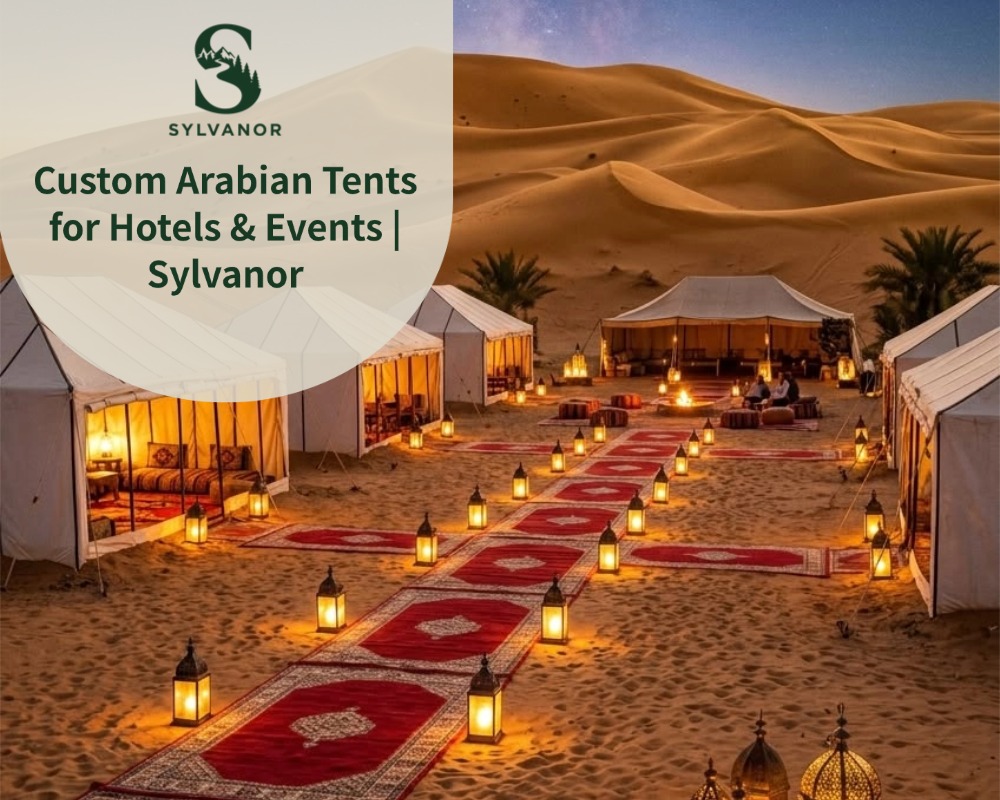





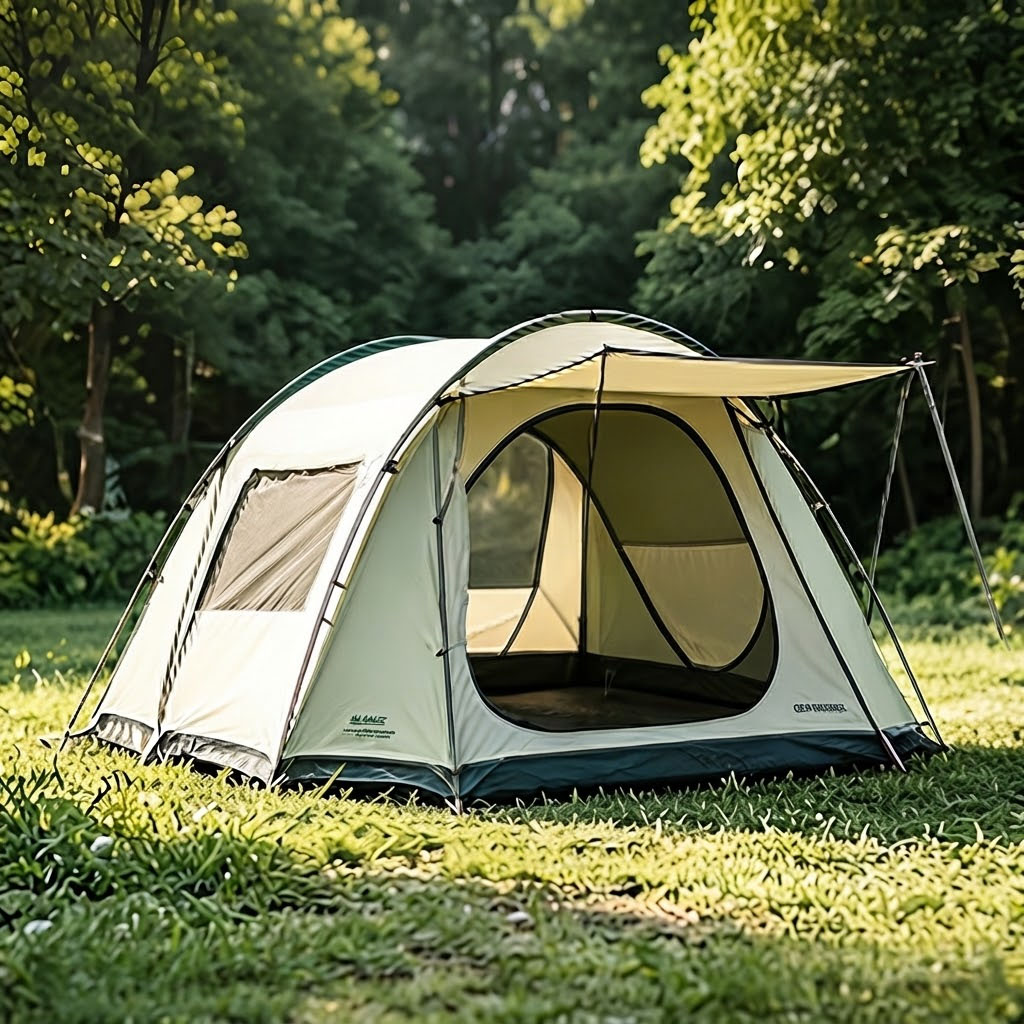

Custom Arabian Tents for Hotels, Resorts & Events: A Buyer’s Guide
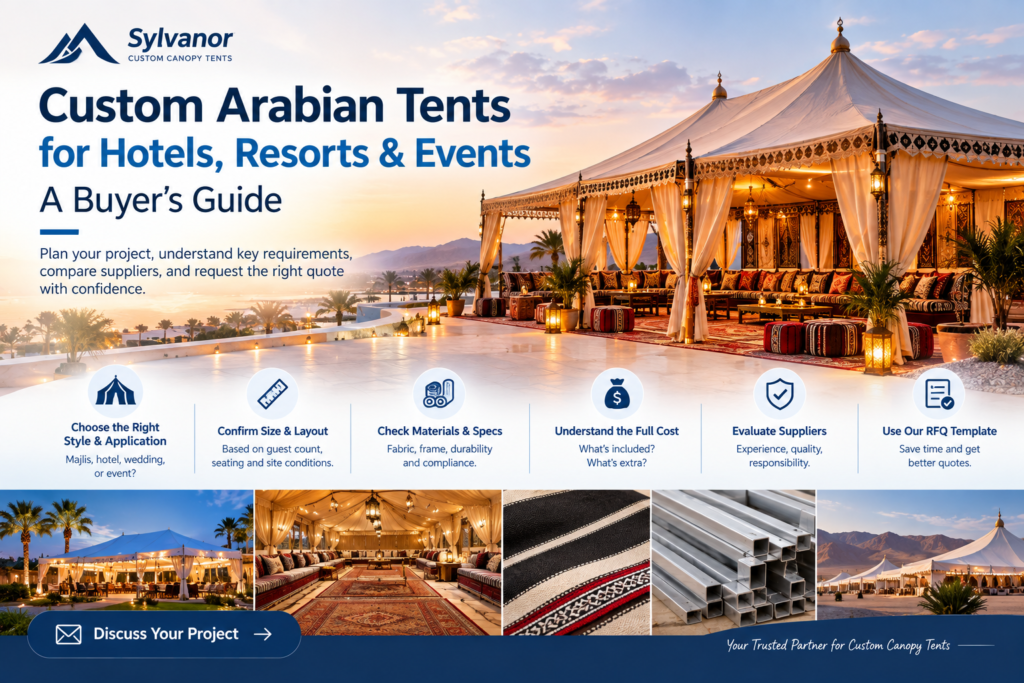
Planning a custom Arabian tent for a hotel, resort, wedding, Majlis, or commercial event?
Choosing the right tent is about more than appearance. You need a design that fits your space, supports your intended use, meets your project requirements, and works within your budget and timeline.
For some buyers, the priority is creating a traditional Arabic Majlis atmosphere. For others, it may be a luxury hospitality space, an outdoor dining area, or a distinctive venue for weddings and corporate events.
Each project has different requirements.
Before requesting a quotation, it helps to understand which design you need, what specifications to confirm, and which questions to ask your supplier.
In this guide, you’ll learn how to:
- Choose an Arabian tent style for your application
- Plan dimensions, seating, and interior layout
- Compare fabric and structural specifications
- Identify costs beyond the tent itself
- Evaluate suppliers and clarify responsibilities
- Prepare an RFQ for your custom tent project
If you already have a project in mind, you can also use the quotation checklist near the end of this article to organize your requirements.
1. What Type of Arabian Tent Does Your Project Need?
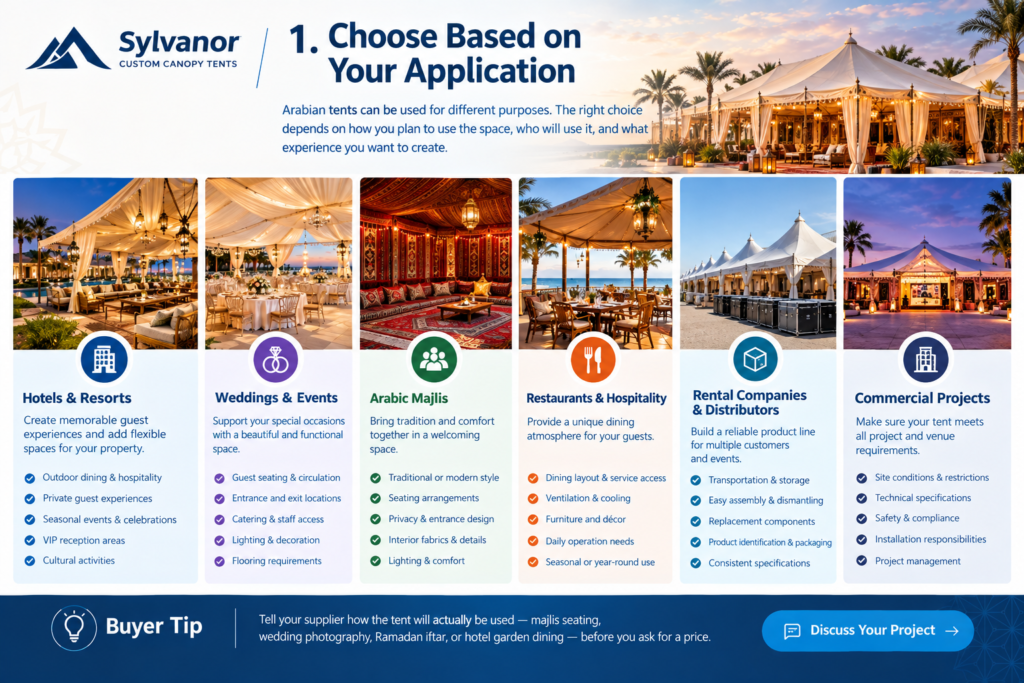
Start with the purpose of your tent.
The intended application affects the design, layout, materials, accessories, and project requirements.
| Application | What to Consider |
|---|---|
| Hotels and resorts | Guest experience, privacy, seating, comfort, and property aesthetics |
| Weddings and events | Guest capacity, entrance locations, decoration, flooring, and event schedule |
| Arabic Majlis | Traditional design, seating arrangements, privacy, and interior finishes |
| Restaurants and hospitality | Dining layout, staff access, ventilation, and daily operation |
| Rental businesses | Transportation, storage, assembly, maintenance, and repeat orders |
| Commercial projects | Site conditions, project specifications, safety requirements, and installation responsibilities |
Arabian Tents for Hotels and Resorts
Hotels and resorts may use Arabian-style tents to create additional hospitality or event spaces.
Before choosing a design, consider:
- How will guests use the space?
- Will it be used for dining, lounging, meetings, or private gatherings?
- How many guests should it accommodate?
- Will the tent be open-sided or enclosed?
- Is cooling or additional ventilation required?
- Does the design need to complement the property’s existing architecture?
A clear description of the guest experience can help your supplier understand the project more effectively.
Arabian Tents for Weddings and Events
For weddings, celebrations, and corporate events, appearance and layout often need to work together.
Consider guest seating, catering access, decorative finishes, lighting, flooring, and the time available for setup and dismantling.
If you have a venue floor plan or reference photographs, share them with your supplier.
These details can help clarify the design before you move forward.
Arabian Tents for Majlis Projects
For a traditional or contemporary Majlis, focus on the atmosphere and the way people will use the space.
Your requirements may include:
- Traditional or modern Arabic-inspired styling
- Seating and furniture arrangements
- Interior fabrics and decorative details
- Privacy and entrance configuration
- Lighting and comfort requirements
Not sure which style is right for your project? Start with the application, the available space, and a few reference images. You can discuss the detailed configuration with a supplier afterward.
2. Choose the Design Before Finalizing the Specifications
Arabian tents can vary in appearance, construction, and configuration.
Rather than relying on the term Arabian tent alone, identify the design you have in mind.
Traditional Arabic-Inspired Design
A traditional design may incorporate Arabic-inspired patterns, decorative fabrics, coordinated colors, and Majlis-style seating.
If the cultural appearance is important to your project, provide reference images and identify the details you want to retain.
Contemporary Arabian Design
A contemporary design may combine Arabic-inspired elements with a modern hospitality or event layout.
You may wish to discuss simplified decoration, modern furniture, custom colors, branded panels, or coordinated lighting.
Large Hospitality and Event Structures
Larger structures need more detailed planning.
The design may need to account for guest capacity, entrances, circulation, internal partitions, service areas, flooring, and equipment.
For large or complex projects, request project-specific drawings and relevant technical information. Confirm whether qualified engineering review or other approvals are required.
Practical tip: Ask the supplier to identify which design features are included in the quoted product and which would require additional customization.
3. How to Choose the Right Size and Layout
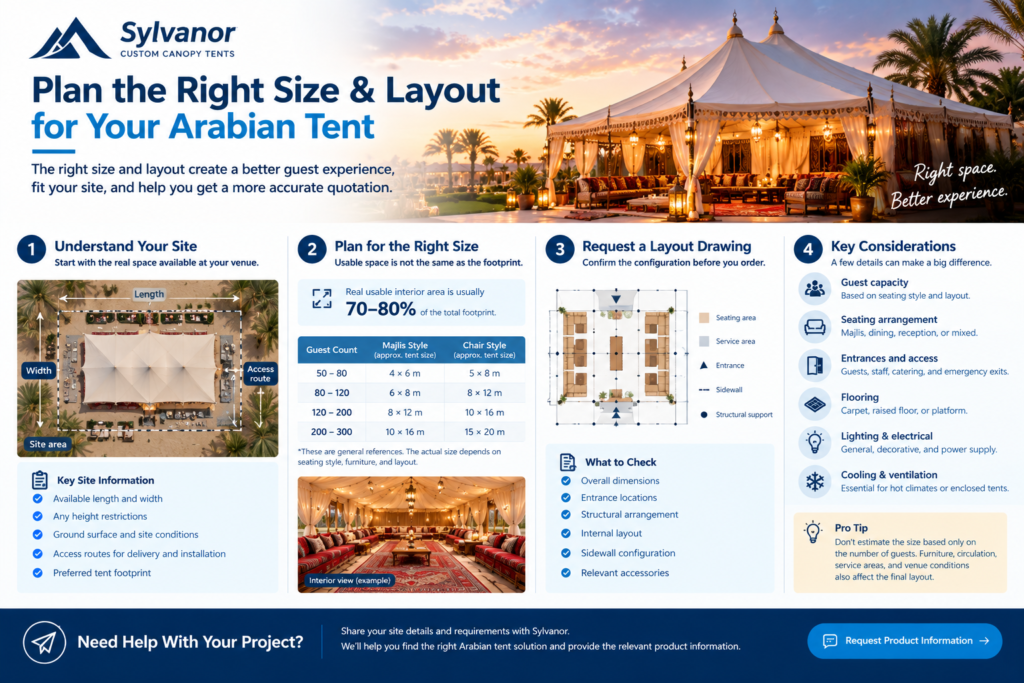
A tent’s external dimensions do not tell you everything about the space available for guests.
Furniture, structural supports, entrances, partitions, and service routes can all affect the usable interior area.
Before requesting a quotation, prepare the following information:
- Available site length and width
- Any height restrictions
- Expected guest capacity
- Preferred seating arrangement
- Required entrances and access points
- Furniture and service-area requirements
- Ground conditions and site restrictions
- Delivery and installation access
If you do not know the final tent dimensions, provide the available site measurements and explain how you intend to use the space.
Request a Layout Drawing
For a customized project, ask whether the supplier can provide a drawing or specification document showing the proposed configuration.
Depending on the project, this may include:
- Overall dimensions
- Entrance locations
- Structural arrangement
- Internal layout
- Sidewall configuration
- Relevant accessories
Review the proposed layout before approving production or installation.
Remember: Guest capacity should not be estimated from the footprint alone. Seating style, furniture dimensions, circulation, and service access also matter.
4. What Materials Should You Discuss With Your Supplier?
Fabric and structural materials affect the appearance, handling, maintenance, and suitability of a tent.
The appropriate choice depends on the intended application, climate, site conditions, design, and applicable requirements.
Fabric Specifications
Depending on the product, possible fabric categories may include traditional-style textiles, canvas, polyester fabrics, PVC-coated fabrics, or other technical textiles.
Ask your supplier to confirm the actual material proposed for your project.
| Specification | What to Confirm |
|---|---|
| Fabric composition | What material is used? |
| Fabric weight | What is the weight and unit of measurement? |
| Coating or treatment | Is a coating or treatment applied? |
| Colors and patterns | Which options are available? |
| Cleaning | What maintenance instructions apply? |
| Performance | What characteristics are claimed, and what documentation supports them? |
| Customization | Can the fabric be customized for your project? |
If you require specific fire-performance, UV, water-resistance, or other technical characteristics, state those requirements before requesting a final quotation.
Ask for documentation applicable to the actual material and product configuration.
Structural Specifications
For the frame or supporting structure, clarify:
- Main structural material
- Relevant dimensions and specifications
- Connection and joint details
- Surface treatment, where applicable
- Anchoring requirements
- Installation instructions
- Documented operating limitations
- Inspection and maintenance recommendations
For large or semi-permanent installations, have the proposed design reviewed by appropriately qualified professionals where required.
Buyer tip: Ask the supplier to distinguish confirmed specifications from options that still require technical review.
5. Plan the Interior: Seating, Flooring, Lighting, and Comfort
For hospitality and event projects, the interior is an important part of the overall experience.
Planning these elements early can help you define the complete scope of supply.
Seating and Furniture
Decide whether you need traditional Majlis seating, cushions, dining tables and chairs, reception furniture, or a combination.
Confirm whether furniture is included in the tent quotation or needs to be sourced separately.
Flooring and Decoration
Depending on the venue and application, you may need carpet, a raised floor, a temporary platform, curtains, interior lining, or decorative panels.
Ask which options are available and which items are outside the supplier’s scope.
Lighting, Cooling, and Ventilation
For enclosed spaces or projects in warm climates, discuss:
- General and decorative lighting
- Electrical connections and cable routing
- Cooling equipment requirements
- Ventilation arrangements
- Power availability
- Equipment placement and maintenance
Confirm the requirements with the venue and relevant qualified professionals.
Do not assume that electrical work, cooling equipment, or installation is included unless it is explicitly stated in the quotation.
6. What Safety and Compliance Requirements Should You Check?
For commercial hospitality and public events, safety and compliance should be considered before the design is finalized.
Requirements vary according to the destination, venue, structure, materials, and intended use.
Before committing to an order, clarify:
- Are permits or venue approvals required?
- Are specific fire-performance documents required?
- Are structural calculations or engineering drawings necessary?
- Are there restrictions on anchoring or ground penetration?
- Are emergency exits or access routes specified?
- Are there requirements for electrical or cooling systems?
- Who is responsible for obtaining and submitting required documents?
- Who will inspect the site and confirm installation arrangements?
Clarify Project Responsibilities
A project may involve the buyer, supplier, venue, installer, freight provider, and other contractors.
Confirm who is responsible for:
| Project Stage | Responsibility to Confirm |
|---|---|
| Product design | Who prepares and approves the configuration? |
| Manufacturing | Who supplies the agreed product? |
| Technical review | Who checks the design against project requirements? |
| Site preparation | Who prepares the installation area? |
| Transportation | Who arranges delivery and unloading? |
| Installation | Who installs and checks the structure? |
| Permits and approvals | Who obtains the required approvals? |
| Inspection | Who conducts any required inspections? |
| Maintenance | Who provides instructions and handles future service requirements? |
A product quotation does not automatically include site preparation, installation, permits, or regulatory approvals.
Confirm the scope in writing.
7. How Much Does a Custom Arabian Tent Cost?
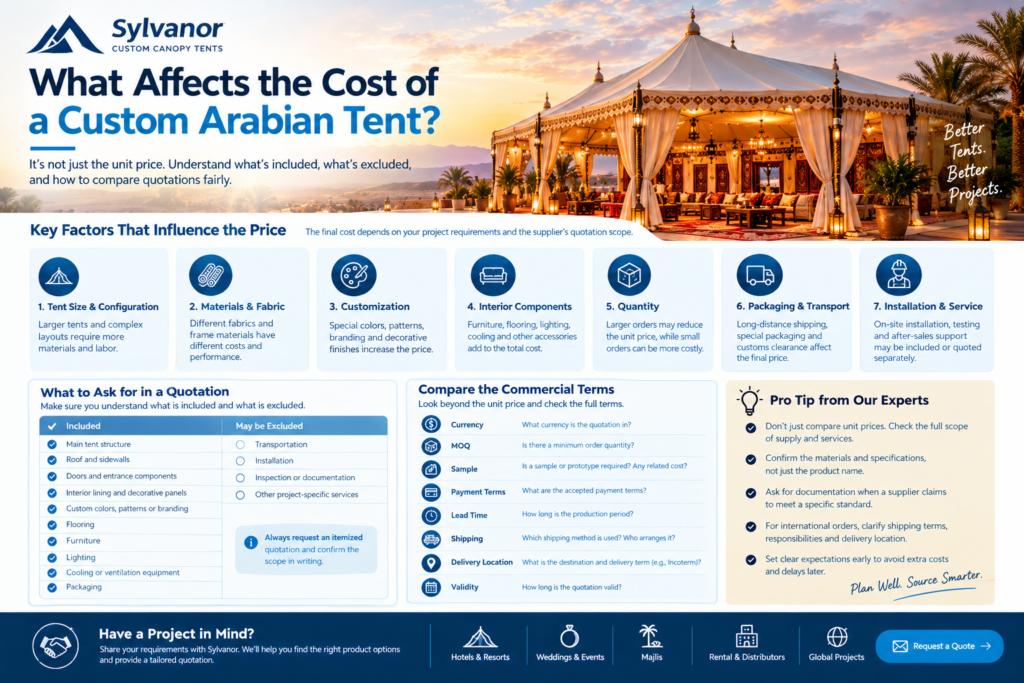
The cost of a custom Arabian tent depends on the product and the project requirements.
A quotation may be affected by:
- Tent dimensions and configuration
- Structural design and materials
- Fabric specifications
- Custom colors, patterns, and branding
- Interior lining and decorative finishes
- Flooring, furniture, and accessories
- Order quantity
- Packaging
- Transportation
- Installation and other project services
This is why two quotations for what appears to be a similar tent may not cover the same scope.
Ask for an Itemized Quotation
Ask your supplier to identify whether the price includes:
- Main tent structure
- Roof and sidewalls
- Doors or entrance components
- Interior lining and decorative panels
- Custom colors, patterns, or branding
- Flooring and furniture
- Lighting and cooling equipment
- Packaging
- Transportation
- Installation
- Inspection or documentation
- Other project-specific services
Also confirm the commercial terms:
- Currency
- Quantity and MOQ, if applicable
- Sample or prototype charges
- Payment terms
- Production lead time
- Shipping arrangement
- Delivery location
- Warranty and after-sales terms
- Quotation validity period
For international purchases, confirm the applicable Incoterm and named location or port.
Do not compare unit prices until you understand what each quotation includes and excludes.
8. How to Evaluate an Arabian Tent Supplier
A product photograph or catalogue can help you understand a design, but it does not confirm every detail of the product or supplier.
Before placing an order, ask questions that help establish the proposed specifications, available evidence, and project responsibilities.
Product and Technical Questions
- What exact product or configuration are you proposing?
- Can you provide the relevant specifications?
- Which customization options are available?
- Can you provide drawings or technical information for review?
- Which requirements are confirmed, and which need further assessment?
Quality and Documentation Questions
- What quality checks are performed?
- What material specifications or test reports can you provide?
- How are sample approvals and design changes documented?
- What inspection arrangements are available?
- What documentation will accompany the order?
Commercial and Project Questions
- What is included in the quotation?
- Which items or services are excluded?
- What is the estimated production schedule?
- What information is required before production can begin?
- Who coordinates transportation and installation, if applicable?
- What warranty and after-sales terms apply?
Verify Important Claims
If a supplier claims that a product meets a particular standard, ask for the relevant documentation.
If a supplier presents previous projects as examples, ask whether the images and details relate to actual completed work and whether references can be shared.
If a supplier proposes a delivery date, ask what assumptions the schedule depends on.
The objective is to establish a clear, documented understanding of the product and commercial arrangement before committing to the order.
9. What Should You Confirm Before Bulk Production?
For customized projects, a sample, prototype, or pre-production approval process may help confirm important details before the full order proceeds.
The appropriate process depends on the product, customization level, project value, and requirements.
Before Sample or Prototype Approval
Confirm:
- Product model and dimensions
- Materials and fabric
- Colors and patterns
- Structural and connection details
- Interior finishes
- Branding and artwork
- Included accessories
- Relevant documentation
Record the approved specifications and any agreed deviations.
Before Bulk Production
Review the final:
- Product specifications
- Drawings and configuration
- Fabric and material details
- Artwork and color approvals
- Quantity and packaging
- Price and payment terms
- Production schedule
- Inspection arrangements
- Shipping and delivery terms
- Responsibility for outstanding approvals
Document any changes before production begins.
Plan Backward From Your Required Date
If the tent is needed for a wedding, seasonal event, hotel opening, or other fixed date, work backward from the date it must be ready for use.
Allow time for requirement confirmation, design review, sample approval, production, inspection, packing, transportation, customs clearance where applicable, site preparation, and installation.
Ask the supplier to provide separate estimates for production and transportation.
A production estimate is not automatically a confirmed delivery or installation date.
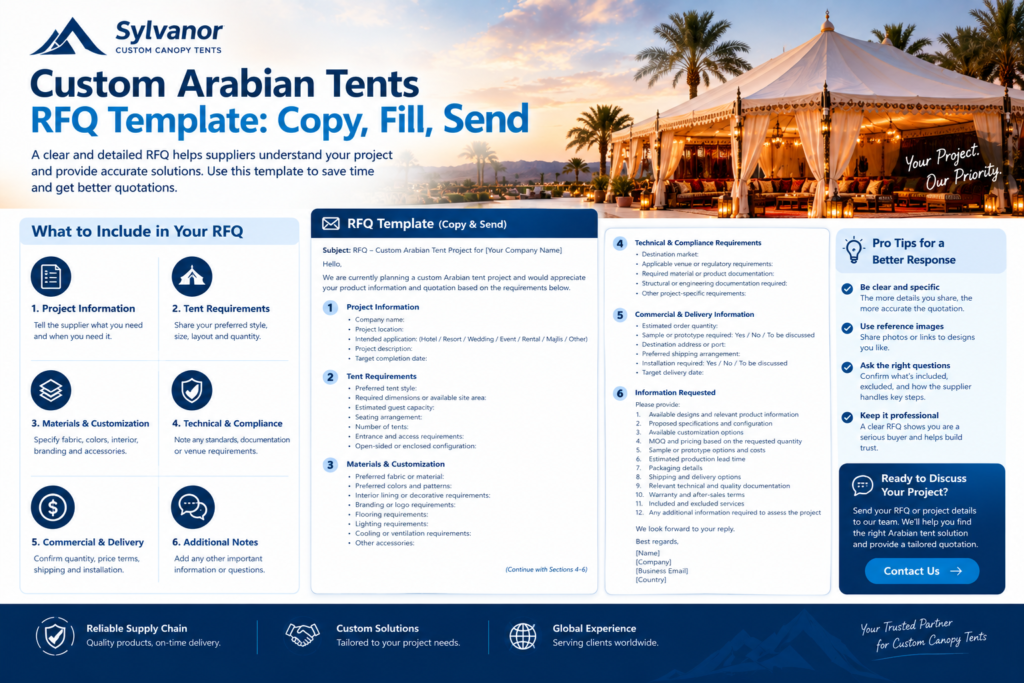
10. Custom Arabian Tent RFQ Template: Copy and Send
Ready to contact suppliers?
Use this template to organize your requirements and request a quotation.
Subject: RFQ – Custom Arabian Tent Project for [Company Name]
Hello,
We are currently planning a custom Arabian tent project and would appreciate your product information and quotation based on the requirements below.
Project Information
- Company name:
- Project location:
- Intended application: Hotel / Resort / Wedding / Event / Rental / Majlis / Other
- Project description:
- Target completion date:
Tent Requirements
- Preferred tent style:
- Required dimensions or available site area:
- Estimated guest capacity:
- Seating arrangement:
- Number of tents:
- Entrance and access requirements:
- Open-sided or enclosed configuration:
Materials and Customization
- Preferred fabric or material:
- Preferred colors and patterns:
- Interior lining or decorative requirements:
- Branding or logo requirements:
- Flooring requirements:
- Lighting requirements:
- Cooling or ventilation requirements:
- Other accessories:
Technical and Compliance Requirements
- Destination market:
- Applicable venue or regulatory requirements:
- Required material or product documentation:
- Structural or engineering documentation required:
- Other project-specific requirements:
Commercial and Delivery Information
- Estimated order quantity:
- Sample or prototype required: Yes / No / To be discussed
- Destination address or port:
- Preferred shipping arrangement:
- Installation required: Yes / No / To be discussed
- Target delivery date:
Information Requested
Please provide:
- Available designs and relevant product information
- Proposed specifications and configuration
- Available customization options
- MOQ and pricing based on the requested quantity
- Sample or prototype options and costs
- Estimated production lead time
- Packaging details
- Shipping and delivery options
- Relevant technical and quality documentation
- Warranty and after-sales terms
- Included and excluded services
- Any additional information required to assess the project
If any requirement needs clarification, please identify it and suggest possible alternatives where appropriate.
We look forward to reviewing your proposal.
Best regards,
[Name]
[Company]
[Business Email]
[Country]
Frequently Asked Questions
What is an Arabian tent?
An Arabian tent generally refers to a tent style associated with Arabic or Middle Eastern design traditions.
Depending on the design and configuration, it may be used for Majlis gatherings, hospitality, weddings, events, or other applications.
The term covers different styles and construction methods, so buyers should confirm the actual product design and specifications with the supplier.
Can Arabian tents be customized?
Customization options depend on the supplier and product.
Potential areas for discussion include dimensions, fabric, colors, patterns, interior layout, entrances, branding, and selected accessories.
Ask the supplier to confirm which options are available for the specific model or project.
What should hotels consider when purchasing an Arabian tent?
Hotels should consider guest capacity, seating layout, service access, interior comfort, site conditions, operating schedule, safety requirements, maintenance, and the responsibilities for delivery and installation.
The project brief should reflect both the desired guest experience and the property’s operational requirements.
What affects the cost of a custom Arabian tent?
Pricing may depend on dimensions, structural design, materials, fabric specifications, customization, interior components, accessories, quantity, packaging, transportation, and installation.
Request an itemized quotation and confirm what is included before comparing suppliers.
Can Arabian tents be used for commercial events?
Some Arabian tent designs may be suitable for commercial events, but suitability depends on the specific structure, intended use, site conditions, applicable regulations, and documented performance.
Confirm the requirements with the supplier, venue, and relevant professionals before use.
Should I request a sample before ordering?
A sample or prototype may be useful when the project involves custom materials, colors, finishes, or other important specifications.
Discuss the available approval process with the supplier and confirm what the sample represents before proceeding.
What documents should I request from an Arabian tent supplier?
The required documents depend on the project and destination market.
Potential documents may include product specifications, drawings, material information, relevant test reports, installation instructions, and other documentation required by the venue or authorities.
Identify the applicable requirements before placing the order.
What information should I provide to receive a quotation?
Start with the intended application, project location, preferred dimensions, estimated quantity, design preferences, material requirements, interior needs, destination, and target timeline.
If some details are undecided, explain what you know and ask the supplier which additional information is needed.
Planning a Custom Arabian Tent Project?
A clear project brief helps make supplier discussions more focused and quotations easier to compare.
Whether you are planning a hospitality space, a traditional Majlis, a wedding venue, or a commercial event project, start with the details you already know.
You do not need to finalize every technical specification before starting the conversation.
Discuss Your Project With Sylvanor
If you are exploring Arabian tents or other outdoor products, share your requirements with Sylvanor so the relevant product options and project details can be discussed.
When contacting us, please include:
- Application: Hotel, resort, wedding, event, rental, Majlis, or other
- Location: Project country and city
- Dimensions: Required size or available site area
- Quantity: Estimated number of tents
- Design: Preferred style, colors, and reference images
- Customization: Materials, interior details, branding, and accessories
- Timeline: Target delivery or event date
Have a project in mind? Contact Sylvanor to discuss your Arabian tent sourcing requirements and request relevant product information.
Let’s start with your project brief and identify the details that need to be confirmed.