

You send the same canopy tent requirements to five suppliers in China.
Three quotations arrive.
One is 22% cheaper. Another includes free sidewalls. A third recommends a different frame and fabric combination than the one you requested.
Which quotation should you choose?
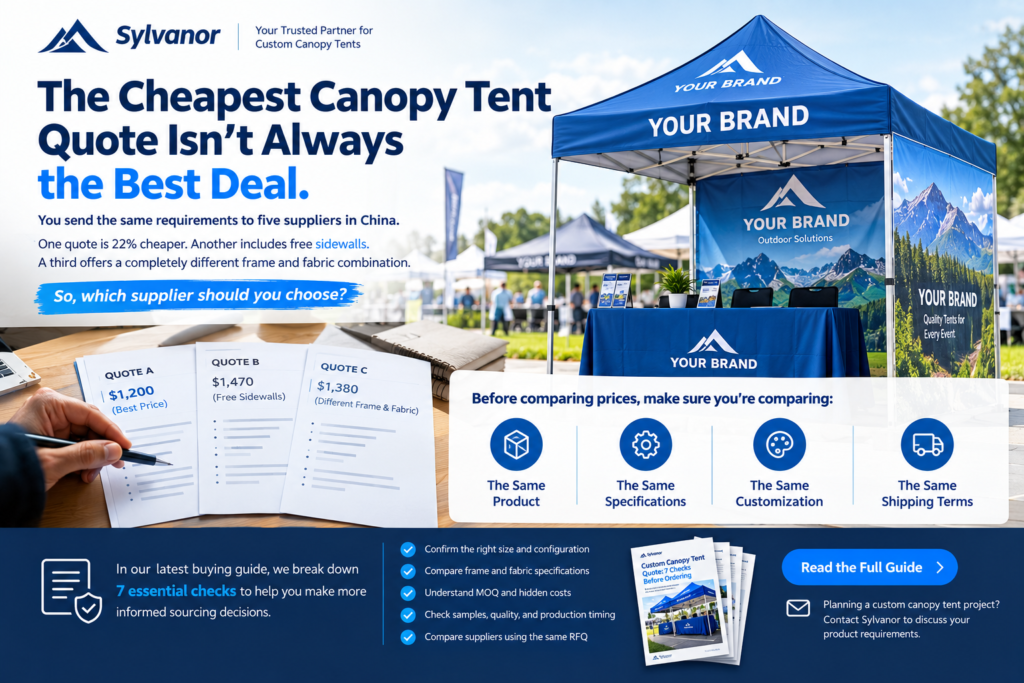
The lowest unit price may look attractive, but it does not always mean the lowest total purchasing cost. Two quotations can describe products with completely different specifications, accessories, printing coverage, quality requirements, and delivery arrangements.
The differences may only become obvious after you place an order — when the frame does not meet your expectations, the printed graphics are incorrect, or additional costs appear before shipment.
For importers, distributors, promotional companies, and event businesses, these problems can affect budgets, schedules, and customer relationships.
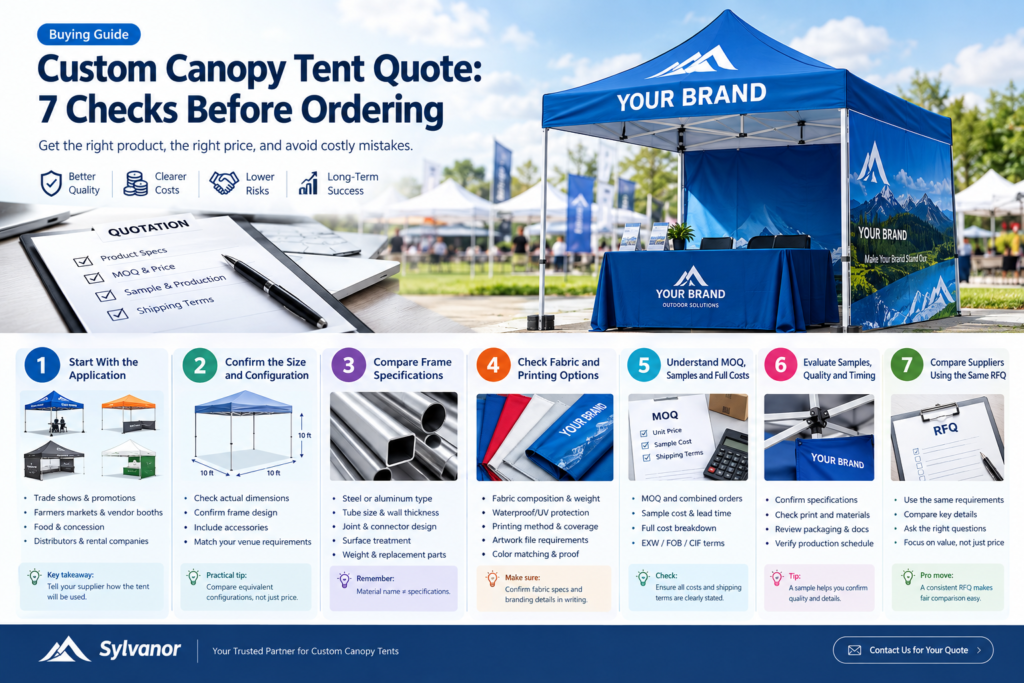
This guide explains seven practical checks to help you request a clearer custom canopy tent quote, compare suppliers on equal terms, and reduce avoidable sourcing risks.
In this guide, you will learn:
- What information suppliers need to prepare an accurate quotation
- Which canopy tent specifications you should confirm before comparing prices
- How frame materials, fabric, and printing affect your requirements
- What to check about MOQ, samples, production, and shipping costs
- How to compare quotations using a consistent RFQ
- A ready-to-use custom canopy tent RFQ template
1. Start With the Application, Not Just the Product Name
Before requesting a quotation, define how you intend to use the canopy tent.
A 10×10 ft canopy for occasional promotional events may have different requirements from a 10×10 ft canopy used repeatedly by a rental company.
The size may be similar, but the expected frequency of use, branding requirements, accessories, and operating environment can differ significantly.
Trade Shows and Brand Promotions
If you are sourcing canopy tents for trade shows, promotional campaigns, or brand activations, consider:
- Logo placement and printing coverage
- Whether graphics need to appear on the roof, valance, or sidewalls
- Color consistency across multiple units
- Transportation and storage requirements
- Whether the design needs to be reproduced for future campaigns
Question to ask your supplier:
Can you provide a quotation based on the exact artwork placement and printing coverage required for our campaign?
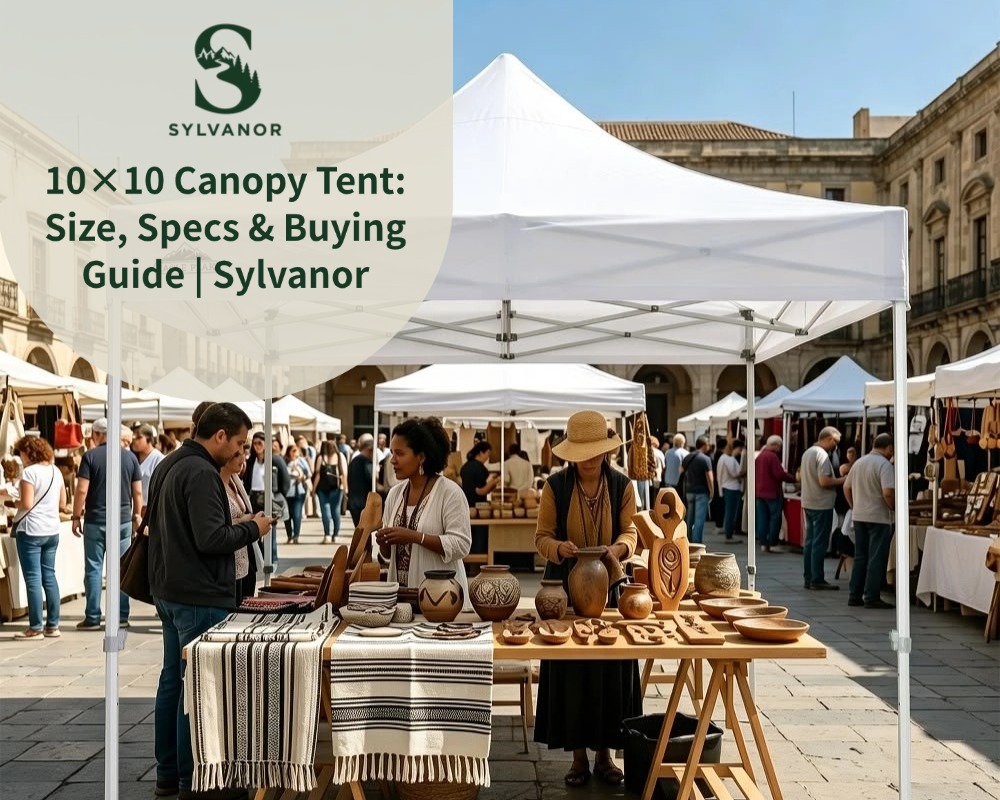
Farmers Markets and Vendor Booths
For market vendors and regular booth operators, consider:
- Venue-specific booth dimensions
- Setup and dismantling frequency
- Frame construction and handling requirements
- Display space and access
- Weights, anchoring, and other accessories
A canopy suitable for one venue may not satisfy another venue’s requirements. Confirm applicable operating limits and anchoring requirements before ordering.
Food and Concession Businesses
For food vendors and concession operations, consider:
- Serving windows and access layout
- Sidewall configuration
- Ventilation requirements
- Cleaning and maintenance
- Applicable fire, safety, or venue requirements
If your market or venue requires specific fire-performance documentation, identify that requirement before requesting a quotation. Do not assume that a general fabric description proves compliance.
Distributors and Rental Companies
If you are purchasing for distribution or rental, you may need to consider the product range as a whole.
Check:
- Consistency between production batches
- Availability of replacement components
- Packaging and product identification
- Options for different sizes and configurations
- Repeat-order requirements
- Expected handling and maintenance needs
Key takeaway: Explain the intended application when requesting a quote. A clear application brief helps suppliers identify relevant configurations instead of simply sending a generic price list.
2. Confirm the Size and Configuration
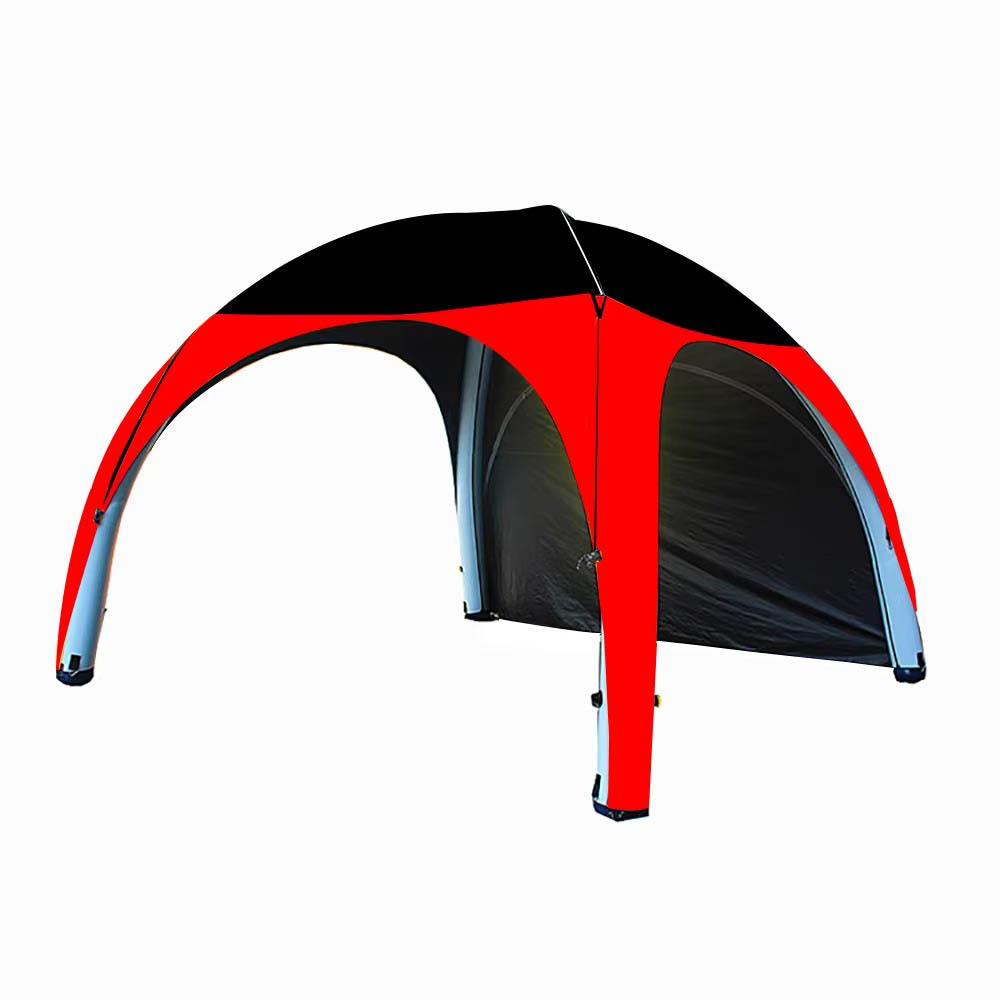
Common canopy tent sizes include 10×10 ft, 10×15 ft, and 10×20 ft.
However, a size label alone is not a complete product specification.
| Nominal Size | Nominal Footprint | Potential Applications |
|---|---|---|
| 10×10 ft | 100 sq ft | Vendor booths, promotional displays, registration areas |
| 10×15 ft | 150 sq ft | Expanded vendor displays and selected event setups |
| 10×20 ft | 200 sq ft | Larger booths, event operations, extended display areas |
These are nominal footprints. They do not guarantee usable interior space, headroom, or capacity for a particular number of people.
What to Confirm Before Requesting a Quote
Ask the supplier to specify:
- Whether the stated dimensions refer to the roof, frame, or ground footprint
- Actual leg spacing
- Available headroom
- Frame configuration
- Whether the quotation includes the canopy top only or a complete tent
- Whether sidewalls, weights, carry bags, or other accessories are included
- Whether the proposed configuration matches your venue requirements
Why Configuration Differences Can Distort Price Comparisons
Consider two quotations for a custom 10×10 ft canopy tent.
| Quotation | Included Configuration |
|---|---|
| Supplier A | Frame, canopy roof, and carry bag |
| Supplier B | Frame, canopy roof, printed sidewalls, and additional accessories |
Supplier A may have a lower unit price, but the two quotations do not cover the same configuration.
Before comparing prices, make sure you are comparing equivalent products.
Practical tip: If you are unsure which size or configuration you need, provide your booth dimensions, intended application, and display requirements. Ask the supplier to explain the available options and their differences.
3. Compare Frame Specifications, Not Just Frame Materials
When sourcing canopy tents, buyers often compare steel and aluminum frames.
However, the material name alone does not tell you enough about the product.
Frame dimensions, wall thickness, joint design, construction, finish, and overall configuration can all affect the product you receive.
If You Are Considering a Steel Frame
Ask the supplier to confirm:
- Tube dimensions
- Wall thickness
- Frame construction
- Joint and connector design
- Surface treatment and corrosion protection
- Overall frame weight
- Availability of replacement components
Two products described as steel canopy tents may have different specifications and construction.
If You Are Considering an Aluminum Frame
Ask about:
- Aluminum alloy or material specification
- Tube dimensions and wall thickness
- Connector and joint construction
- Overall frame weight
- Included components
- Documented operating limitations
Request the actual specifications for the model being quoted rather than relying on a general description of the material.
Steel vs. Aluminum: What Should Buyers Compare?
| Factor | Steel Frame | Aluminum Frame |
|---|---|---|
| Material specification | Steel type and construction details | Aluminum alloy and construction details |
| Weight | Depends on dimensions and construction | Depends on alloy, dimensions, and construction |
| Cost | Depends on material, design, and manufacturing | Depends on material, design, and manufacturing |
| Corrosion considerations | Surface treatment, environment, and maintenance matter | Alloy, finish, environment, and maintenance matter |
| Product suitability | Evaluate against the intended application | Evaluate against the intended application |
Neither material is automatically the right choice for every project.
The decision should be based on the actual frame specifications, intended use, handling requirements, documented performance, and total purchasing cost.
What to request: Ask each supplier to include the frame specifications in the quotation. If a specification is unavailable, ask the supplier to identify that limitation rather than treating it as confirmed.
4. Check Fabric Specifications and Custom Branding Options
Fabric affects the appearance, weight, maintenance requirements, and suitability of a canopy tent for its intended application.
Instead of asking only for “premium fabric,” request specific information.
Fabric Specification Checklist
Confirm:
- Fabric composition
- Fabric weight and unit of measurement
- Coating or treatment
- Available colors
- Printing compatibility
- Seam construction
- Cleaning and storage instructions
- Applicable test reports or supporting documentation
If you require water resistance, UV protection, or another performance characteristic, state the requirement clearly and request supporting documentation for the proposed product.
A general fabric description is not proof that the finished canopy meets a particular performance standard.
Custom Printing: What Should You Confirm?
| Printing Requirement | Questions to Ask |
|---|---|
| Logo placement | Which panels will carry the logo? |
| Roof printing | Is roof printing required and included? |
| Valance printing | Will text or logos appear on the valance? |
| Sidewalls | Are sidewalls included? Will they be printed or plain? |
| Artwork files | Which file formats and specifications are accepted? |
| Color matching | What color references and approval process are used? |
| Multiple designs | How many artwork versions are required? |
| Design approval | Will a digital proof or physical sample be provided? |
A canopy with a single logo may involve different production requirements from a canopy with full-panel branding.
When comparing quotations, confirm that the printing method, coverage, artwork versions, and approval process are consistent.
Key takeaway: Confirm fabric specifications and branding requirements in writing. This helps align the quotation, approved sample, and final order.
5. Understand MOQ, Sample Costs, and the Full Quotation
Minimum order quantity (MOQ) is not necessarily the same for every canopy tent.
It may vary depending on the supplier, model, dimensions, artwork, customization requirements, and production setup.
Questions to Ask About MOQ
- What is the MOQ for the exact model and configuration?
- Does the MOQ apply per size, color, or artwork design?
- Can different sizes or configurations be combined in one order?
- Is a sample order available?
- Are there additional customization or setup charges?
- Do repeat orders have the same MOQ requirements?
If you are testing a new product range, ask for quotations at different order quantities.
For example, you might request pricing for your initial order and a larger planned order. Ask the supplier to confirm the actual pricing and terms for each quantity rather than assuming that a particular volume automatically qualifies for a discount.
Check the Full Cost Structure
Unit price is only one part of the purchasing decision.
Depending on the supplier and the agreed arrangement, the quotation may include or exclude:
- Manufacturing
- Custom printing
- Artwork preparation
- Sample charges
- Special packaging
- Accessories
- Inspection
- Inland transportation
- International shipping
- Other applicable charges
Ask the supplier to identify what is included, what is excluded, and which costs remain subject to confirmation.
EXW, FOB, and CIF: Why Shipping Terms Matter
These trade terms allocate costs, responsibilities, and risks differently.
- EXW (Ex Works): The seller makes the goods available at the agreed location, subject to the agreed terms.
- FOB (Free on Board): The seller delivers the goods on board the vessel at the agreed port, subject to the applicable Incoterms rules.
- CIF (Cost, Insurance and Freight): The seller arranges cost, insurance, and freight to the named destination port, subject to the applicable Incoterms rules.
These terms are not interchangeable price labels. The named place or port, Incoterms version, and contract details matter.
Practical tip: Request a clear cost breakdown and make sure each supplier is quoting against the same delivery arrangement. A lower unit price is difficult to evaluate if the included services and shipping terms are different.
6. Evaluate Samples, Quality, and Production Timing
A sample can help you evaluate a custom canopy tent before committing to a larger order.
For branded products, it can also help confirm the appearance and placement of the artwork.
Before Ordering a Sample, Confirm:
- The exact model and specifications
- Whether the sample will include your actual artwork
- Whether it represents the proposed bulk-production configuration
- Sample cost and shipping charges
- Estimated sample preparation time
- Whether sample charges can be credited toward a later order
Do not assume that a sample automatically represents every detail of future bulk production. Ask the supplier to confirm which specifications and components will remain the same.
When the Sample Arrives, Check:
| Inspection Area | What to Review |
|---|---|
| Dimensions | Do the measurements match the agreed specifications? |
| Configuration | Are the frame, roof, sidewalls, and accessories correct? |
| Frame assembly | Do the connections and assembly process match expectations? |
| Fabric | Does the material match the agreed description and appearance? |
| Printing | Are logo placement, artwork, and colors acceptable? |
| Packaging | Does the packaging meet your handling and shipping requirements? |
| Documentation | Are the agreed specifications and applicable documents provided? |
Record any changes or corrections and obtain written confirmation before approving production.
Confirm the Production Timeline
If your order is connected to a trade show, festival, seasonal campaign, or product launch, discuss timing early.
Ask the supplier to separate the expected stages:
- Sample preparation
- Artwork preparation and approval
- Material preparation
- Production
- Inspection and packing
- Dispatch
- Estimated shipping and delivery
Also ask what starts the production lead time. It may depend on a deposit, artwork approval, sample approval, or another agreed milestone.
Important: A production estimate and a shipping estimate are not automatically guaranteed delivery dates. Confirm the schedule, assumptions, and responsibilities in writing.
7. Compare Suppliers Using the Same RFQ
Once your requirements are clear, send the same Request for Quotation (RFQ) to every supplier.
This makes it easier to identify differences in product configuration, pricing, and service terms.
What Should Your RFQ Include?
At a minimum, provide:
- Product type
- Dimensions
- Intended application
- Frame requirements
- Fabric requirements
- Printing coverage
- Accessories
- Estimated order quantity
- Packaging requirements
- Destination country
- Target delivery date
If you are uncertain about a specification, identify it as undecided and ask suppliers to quote clearly defined alternatives.
Supplier Comparison Checklist
Use the following table to organize the quotations you receive.
| Item | Supplier A | Supplier B | Supplier C |
|---|---|---|---|
| Exact product model | |||
| Dimensions and configuration | |||
| Frame material and specifications | |||
| Fabric specifications | |||
| Printing method and coverage | |||
| Accessories included | |||
| MOQ | |||
| Sample cost | |||
| Unit price and currency | |||
| Packaging | |||
| Production lead time | |||
| Shipping terms | |||
| Quality documentation | |||
| Warranty and after-sales terms |
Do not treat an unconfirmed specification as equivalent to a documented one.
If a supplier leaves an important item blank, request clarification before making your comparison.
Questions That Help You Understand a Supplier’s Capabilities
Ask:
- Do you manufacture this product or source it from another supplier?
- Can you provide the specifications for the exact model quoted?
- What quality checks are performed, and at which production stages?
- How are artwork and sample approvals documented?
- What is the process if delivered goods do not meet the agreed specifications?
- Are replacement components available for this model?
- What product and compliance documentation can you provide for our destination market?
- Which parts of the quotation are confirmed, and which remain subject to change?
The purpose is not simply to collect the lowest price. It is to understand what each supplier is actually offering and whether the proposed arrangement fits your purchasing requirements.
Custom Canopy Tent RFQ Template: Copy and Send
Use the template below when contacting canopy tent suppliers.
Subject: RFQ – Custom Canopy Tents for [Company Name]
Hello,
We are currently sourcing custom canopy tents and would appreciate a quotation based on the requirements below.
1. Product Details
- Product type:
- Tent dimensions:
- Intended application:
- Estimated order quantity:
2. Frame and Fabric
- Preferred frame material:
- Frame specifications, if available:
- Fabric requirements:
- Required performance or compliance characteristics:
3. Customization
- Logo printing: Yes / No
- Required printing coverage:
- Artwork available: Yes / No
- Sidewalls and accessories:
- Packaging requirements:
4. Order and Delivery
- Destination country:
- Preferred shipping arrangement:
- Target delivery date:
- Sample required: Yes / No
5. Information Requested
Please include the following in your quotation:
- Product specifications and available configurations
- MOQ for the requested product
- Unit price based on the estimated order quantity
- Sample cost and estimated preparation time
- Estimated production lead time
- Available customization options
- Packaging details
- Shipping terms and applicable additional charges
- Relevant quality documentation
- Warranty and after-sales terms
If any requirement is unclear or unavailable, please identify the limitation and suggest suitable alternatives where possible.
We look forward to reviewing your quotation.
Best regards,
[Name]
[Company]
[Email]
[Country]
Frequently Asked Questions
1. How do I request a custom canopy tent quote from China?
Prepare your product type, dimensions, quantity, intended application, frame and fabric requirements, printing details, accessories, destination, and timeline.
Send the same RFQ to each supplier and ask them to confirm the exact product configuration and terms in their quotation.
2. What affects the price of a custom canopy tent?
Pricing may be affected by dimensions, frame construction, fabric specifications, printing coverage, accessories, order quantity, packaging, sample requirements, and shipping terms.
The impact of each factor depends on the product and supplier. Request an itemized quotation to understand the actual costs.
3. What is the MOQ for custom canopy tents?
MOQ varies by supplier, model, customization requirements, and production setup.
Ask whether the MOQ applies per model, size, color, or artwork design, and whether different configurations can be combined in one order.
4. Can I order canopy tents with my company logo?
Custom printing may be available depending on the product and supplier.
Confirm the available printing methods, accepted artwork formats, printing coverage, color requirements, and approval process before placing an order.
5. Should I request a sample before placing a bulk order?
A sample can help you evaluate the product and confirm important specifications before a larger purchase.
Whether a sample is necessary depends on the project value, degree of customization, product requirements, and purchasing risks. If you request one, confirm whether it represents the proposed bulk-production configuration.
6. How long does canopy tent production take?
Production timing depends on the product, quantity, customization, material availability, and supplier schedule.
Ask for separate estimates covering sampling, artwork approval, production, inspection, packing, and shipping. Confirm the assumptions behind each estimate.
7. How do I compare canopy tent suppliers fairly?
Send each supplier the same specifications, estimated quantity, customization requirements, and delivery information.
Compare the exact configuration, materials, printing, accessories, MOQ, pricing, packaging, schedule, shipping terms, and available quality documentation.
8. What should I confirm before approving production?
Confirm the final product specifications, artwork, sample approval where applicable, quantity, price, payment terms, production schedule, inspection arrangements, packaging, and delivery terms.
Keep written records of the agreed requirements and any approved changes.
9. What information should I include when asking for a wholesale canopy tent quotation?
Include the product type, dimensions, estimated quantity, intended application, frame and fabric requirements, printing coverage, accessories, packaging, destination country, and target delivery date.
If some requirements are undecided, explain what you know and ask the supplier to identify available options.
Planning a Custom Canopy Tent Project?
A successful sourcing project begins with a clear understanding of your business requirements.
The right canopy tent configuration depends on your application, branding, quantity, budget, and delivery expectations. Defining these details before requesting quotations can make supplier discussions more focused and help you compare proposals more accurately.
At Sylvanor, we help buyers explore outdoor and promotional product options and clarify their sourcing requirements.
Whether you are planning a branded event canopy, a vendor booth, or a wholesale purchasing project, sharing your requirements is a practical first step toward identifying relevant product options.
Request Product Information or Discuss Your Requirements
When contacting us, please include:
- Product: Canopy tent type and dimensions
- Quantity: Estimated order volume
- Customization: Logo, printing, colors, and accessories
- Application: Trade show, market, event, promotion, or other use
- Destination: Country or region
- Timeline: Target delivery date
Still deciding on specifications? That is fine. Describe your intended application and the options you are considering.
Contact Sylvanor to discuss your canopy tent sourcing requirements and request relevant product information.
A clear RFQ is the first step toward a more efficient purchasing process.