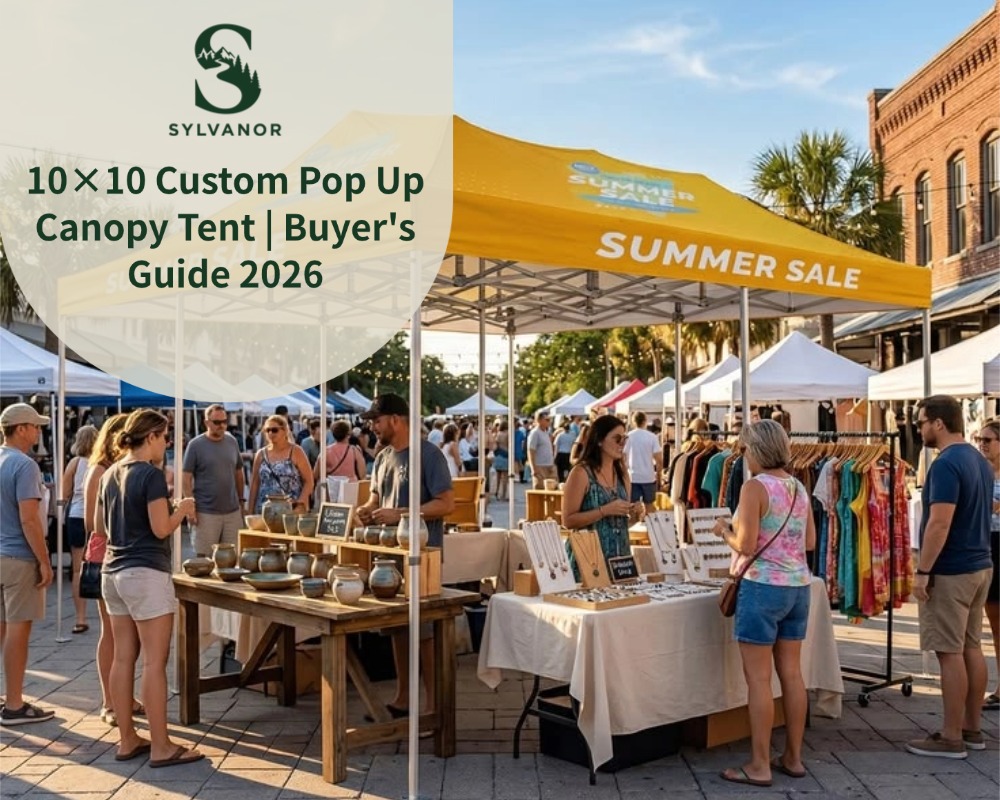
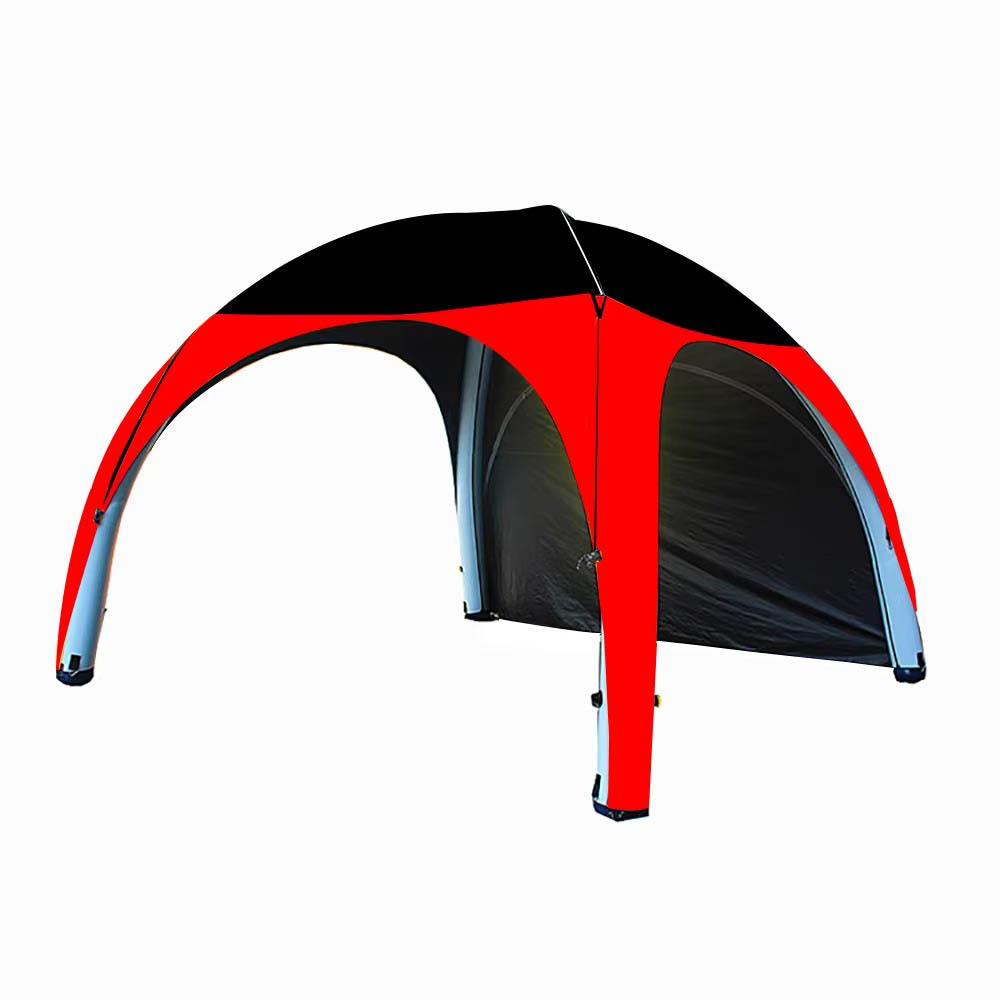
10×10 Custom Pop Up Canopy Tent: What Should You Actually Buy?
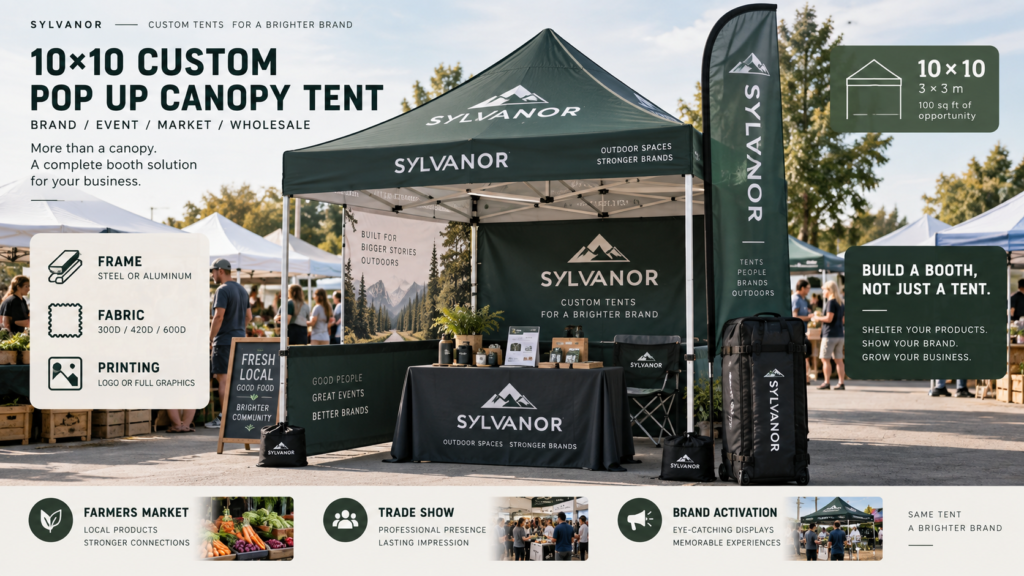
Steel or aluminum? 300D or 600D? Logo print or full graphics? Basic canopy or a complete branded booth?
If you source 10×10 custom pop up canopy tents, finding suppliers is easy.
The real headache? Two tents that look almost identical can have massive differences in price, weight, durability and resale value.
Many buyers get burned here. You get a low quote, receive goods, and find out the frame bends, fabric fades fast, or printing fails to meet your client’s expectations.
All the difference comes down to 5 core factors:
Frame → Fabric → Printing → Accessories → Intended Use
If you are a distributor, event company, promotional brand or private‑label seller, these choices directly affect: ✅ MOQ requirements ✅ Shipping costs ✅ Product profit margin ✅ End‑user satisfaction ✅ Repeat re‑order rates
This guide helps you avoid overpaying for specs you don’t need, and avoid cutting corners where quality matters most.
In a Hurry? Start Here.
Know exactly what you need? Jump straight to your use‑case. Still comparing options? Keep reading for full breakdown.
| If You Need… | Start With… | Main Priority |
|---|---|---|
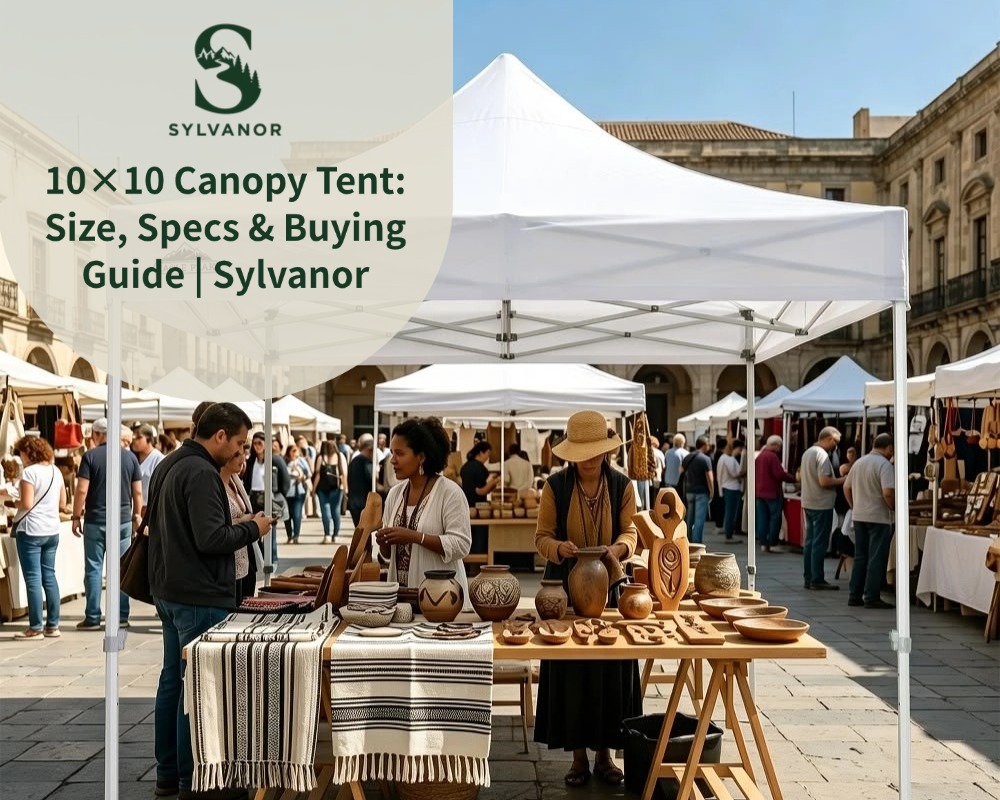
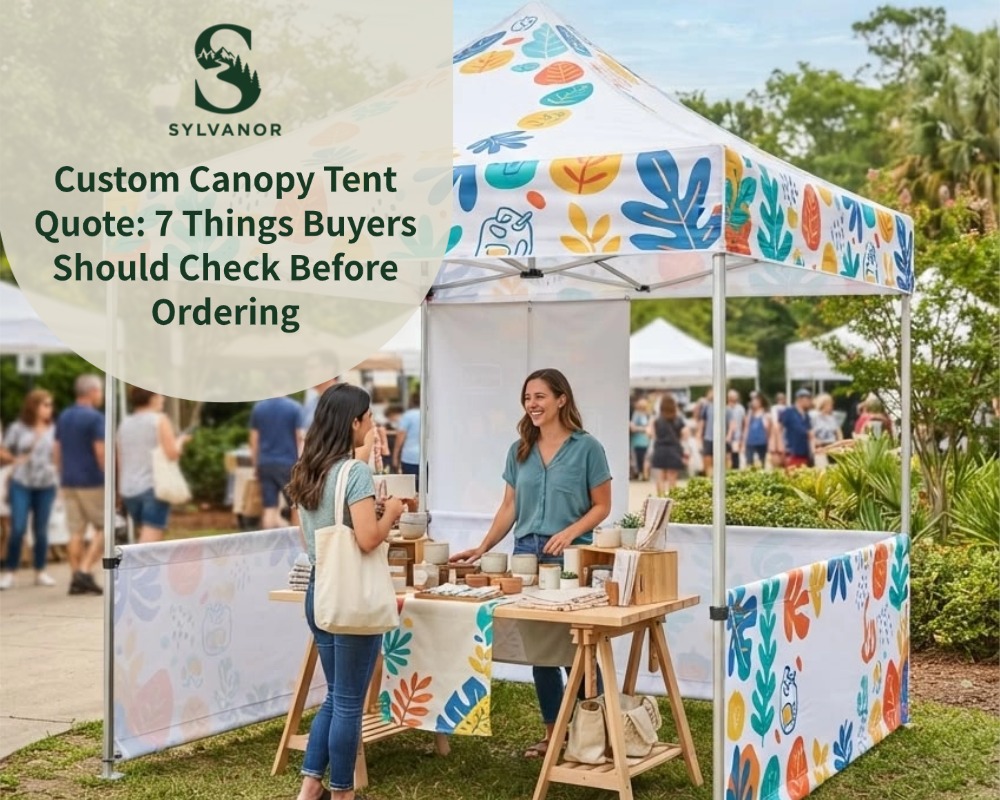
| Farmers Market Tent | 10×10 + branded roof + backwall | Portability + brand visibility |
| Food Vendor Tent | 10×10 + walls + serving window | Practical functionality |
| Trade Show Tent | 10×10 + full graphics | Premium brand presentation |
| Frequent Event Tent | Commercial‑grade frame | Repeated setup & durability |
| Promotional Tent | Cost‑effective configuration | Budget‑focused |
| Private Label Product | OEM configuration + custom packaging | Batch consistency & profit margin |
| Rental / Event Supply | Commercial frame + spare parts | Long‑term durability |
Already Know Your Application?
Send us these simple details: Application + Quantity + Target Market + Logo + Destination We will build your ideal configuration for you.
→ GET MY 10X10 CANOPY CONFIGURATION
Why Is 10×10 Such a Popular Canopy Size?
It hits the sweet spot for commercial buyers:
Large enough for a full branded booth. Small enough to stay portable.
A 10×10 ft canopy gives you 100 sq ft of covered space.
You can fit:
- Product display tables
- Working space for staff
- Product samples
- Merchandise displays
- Food service equipment
- Promotional materials
- Space for customer interactions
without investing in much larger, bulky event structures.
10×10 is the industry standard for farmers markets, vendor booths and trade shows. That makes it the default starting point for most wholesale canopy lines.
Size is simple. The next details will make or break your bulk order.
Why Do Two 10×10 Canopies Have Completely Different Prices?
You have seen this when you send out RFQs:
Supplier A
$
Supplier B
$$
Supplier C
$$$
It’s tempting to pick the lowest bid right away.
But ask yourself this critical question:
Are these suppliers quoting the exact same tent?
In most cases, they are not.
Compare These Before Comparing Price
表格
| Specification | Supplier A | Supplier B | Supplier C |
|---|---|---|---|
| Frame Material | ? | ? | ? |
| Leg Profile | ? | ? | ? |
| Wall Thickness | ? | ? | ? |
| Fabric | ? | ? | ? |
| Coating | ? | ? | ? |
| Printing Coverage | ? | ? | ? |
| Backwall | ? | ? | ? |
| Carry Bag | ? | ? | ? |
| Weights | ? | ? | ? |
| Packaging | ? | ? | ? |
| Artwork Proof | ? | ? | ? |
| MOQ | ? | ? | ? |
Stop asking:
“What’s your cheapest 10×10 canopy?”
Instead ask:
“What exactly am I getting for this price?”
💡 BUYER TIP: Compare specifications first. Compare prices second.
→ GET PRICE & MOQ
What Procurement Teams Actually Evaluate
Price alone will never win a wholesale contract. Professional buyers judge suppliers on these real‑world criteria:
- Delivery reliability: Can they hit promised ship dates for repeat bulk orders?
- Quality consistency: Does unit #10 match your approved sample?
- Responsiveness: How fast do they handle artwork revisions and production questions?
- Cost accuracy: No hidden fees for so‑called “standard” add‑ons.
- Compliance readiness: Fire certificates, test reports and export docs ready on demand.
These points separate one‑off deals from scalable, long‑term product programs.
Steel or Aluminum—Which One Should You Buy?
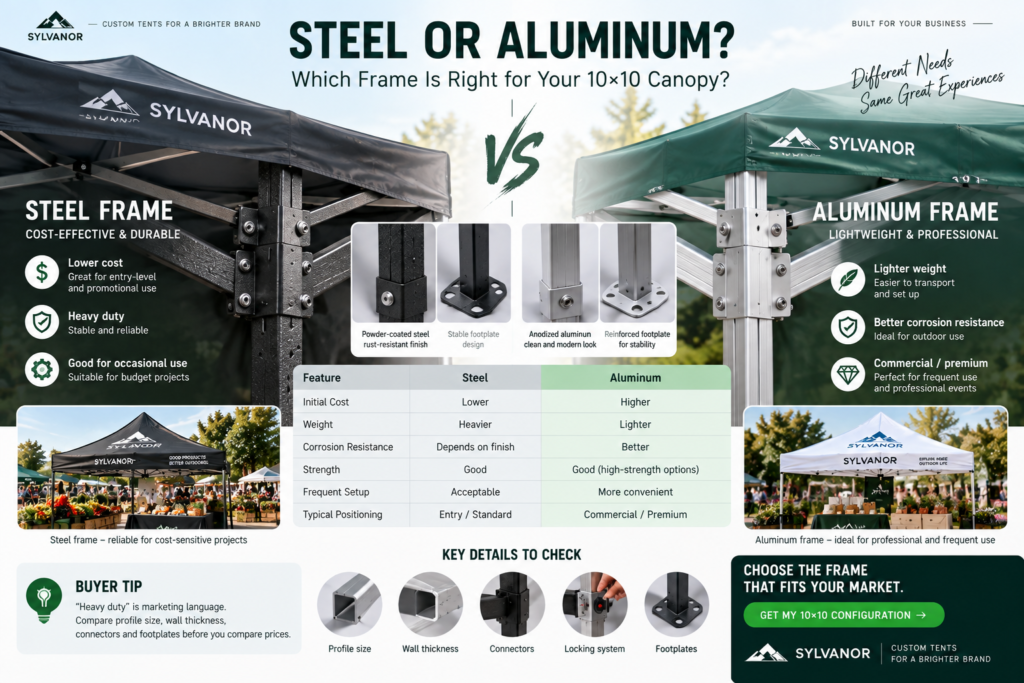
Don’t start with “which material is better”. Start with how your customers will actually use the tent.
Pick steel for budget‑focused, occasional‑use projects. Choose aluminum for frequent travel, repeated setup, and when lower shipping weight matters more than upfront cost.
Choose Steel If:
✓ Budget is your top priority ✓ Tents are used only occasionally ✓ Extra weight is acceptable ✓ You target entry‑level promotional markets
Consider Aluminum If:
✓ Tents travel often ✓ Repeated setup and teardown is required ✓ Lower shipping weight is critical ✓ You need good corrosion resistance ✓ You serve professional commercial end‑users
| Feature | Steel | Aluminum |
|---|---|---|
| Initial Cost | Lower | Higher |
| Weight | Heavier | Lighter |
| Corrosion Resistance | Depends on finish quality | Excellent |
| Frequent Transport | Acceptable | Much more convenient |
| Typical Market Positioning | Entry / Standard | Commercial / Premium |
Important note:
Even two aluminum frames can be very different products. Always confirm these details: Profile Size + Wall Thickness + Connectors + Locks + Footplates + Spare Parts Availability
💡 BUYER TIP: “Heavy‑duty” is marketing buzzword. Real specs are numbers and material grades.
Do You Really Need 600D Fabric?
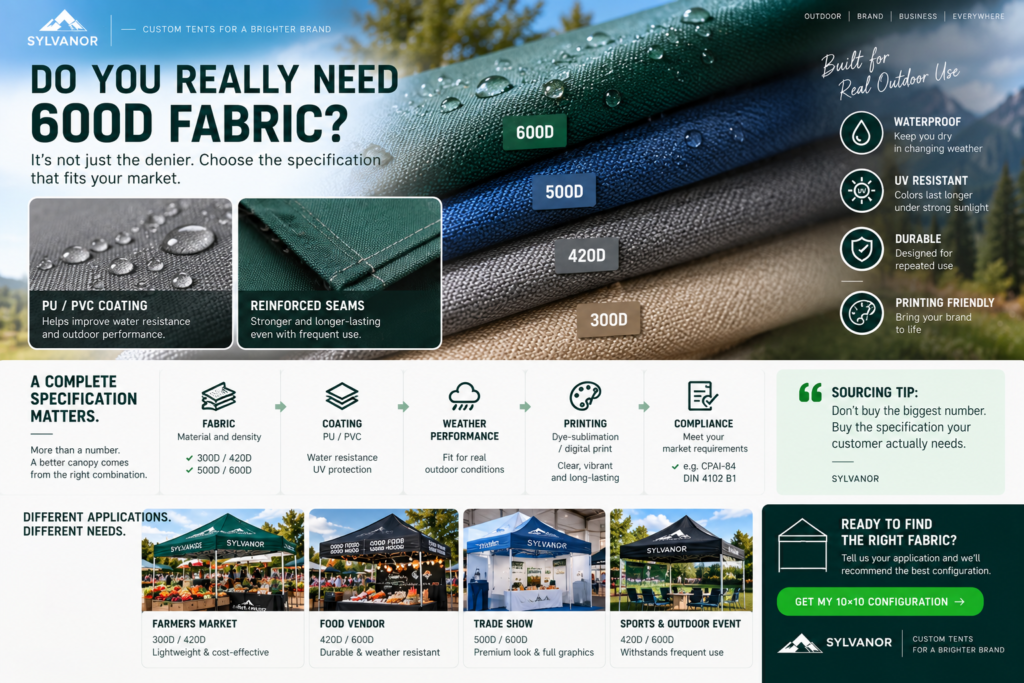
Not always.
Many buyers chase the highest denier number, assuming bigger = better. That is a common sourcing mistake
Fabric choice should be based on: ✅ Application ✅ Protective coating ✅ Printing requirements ✅ Weather performance ✅ Your target market
Buyers often compare: 300D → 420D → 500D → 600D
The right evaluation flow:
FABRIC
What is the base material? ↓
COATING
What protective coating is applied? ↓
WEATHER PERFORMANCE
What real‑world performance is guaranteed? ↓
PRINTING
Which printing process will be used? ↓
COMPLIANCE
What standards does your market require?
600D Oxford polyester is widely used in commercial canopies, paired with full‑color printing and heavy‑duty frames. But it is a complete product configuration — not proof that “600D” alone makes a tent superior.
💡 SOURCING TIP: Do not chase the largest denier number. Buy the spec your customer actually needs.
Don’t Just Buy a Tent. Build a Complete Booth.
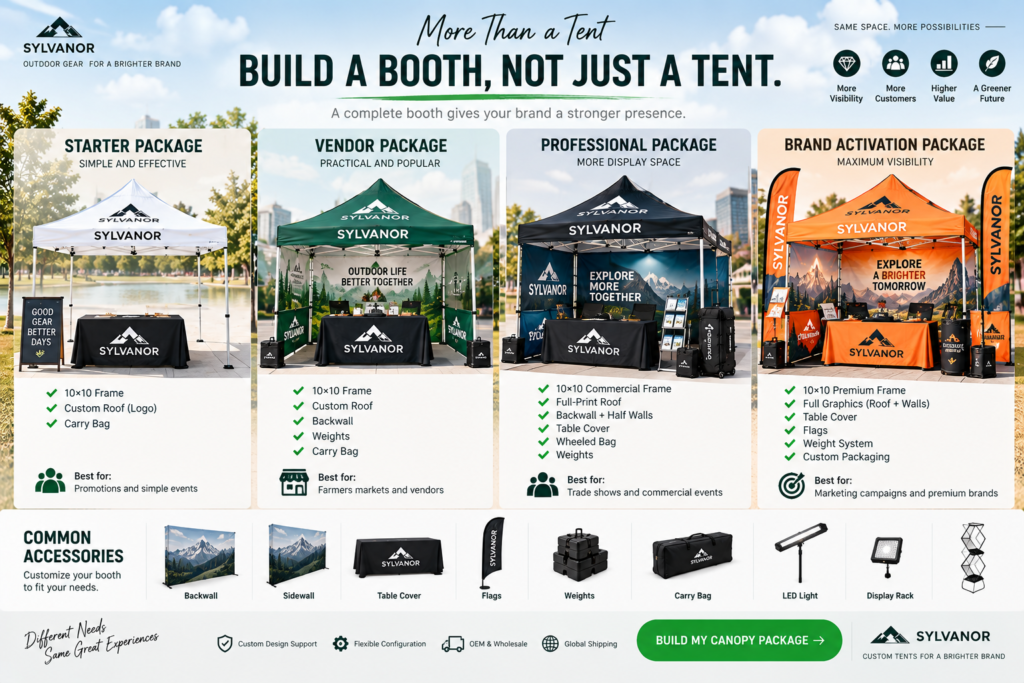
A basic canopy only gives shelter. A full booth creates real brand presence.
Do not stop at just:
CANOPY + FRAME
Consider the full booth system:
CANOPY
↓
BACKWALL
↓
SIDEWALLS
↓
TABLE COVER
↓
FLAGS
↓
WEIGHTS
↓
CARRY BAG
↓
PRIVATE‑LABEL PACKAGING
For distributors, this is how you move away from commodity price wars. Instead of selling generic tents, you can offer tiered packages for different customers.
STARTER PACKAGE
Best for: One‑off promotions & simple events 10×10 Frame
- Custom Roof
- Carry Bag
VENDOR PACKAGE
Best for: Farmers markets & recurring vendor use 10×10 Frame
- Custom Roof
- Backwall
- Weights
- Carry Bag
PROFESSIONAL PACKAGE
Best for: Trade shows & high‑volume commercial events 10×10 Commercial Frame
- Full‑Print Roof
- Backwall
- Half Walls
- Table Cover
- Wheeled Bag
- Weights
BRAND ACTIVATION PACKAGE
Best for: Marketing campaigns & premium brand activations 10×10 Premium Configuration
- Full‑wrap Graphics
- Full Walls
- Table Cover
- Branded Flags
- Weight System
- Custom Private‑Label Packaging
This complete‑booth approach is industry standard today. Top canopy suppliers bundle multiple accessories instead of selling only roof and frame.
→ BUILD MY CANOPY PACKAGE
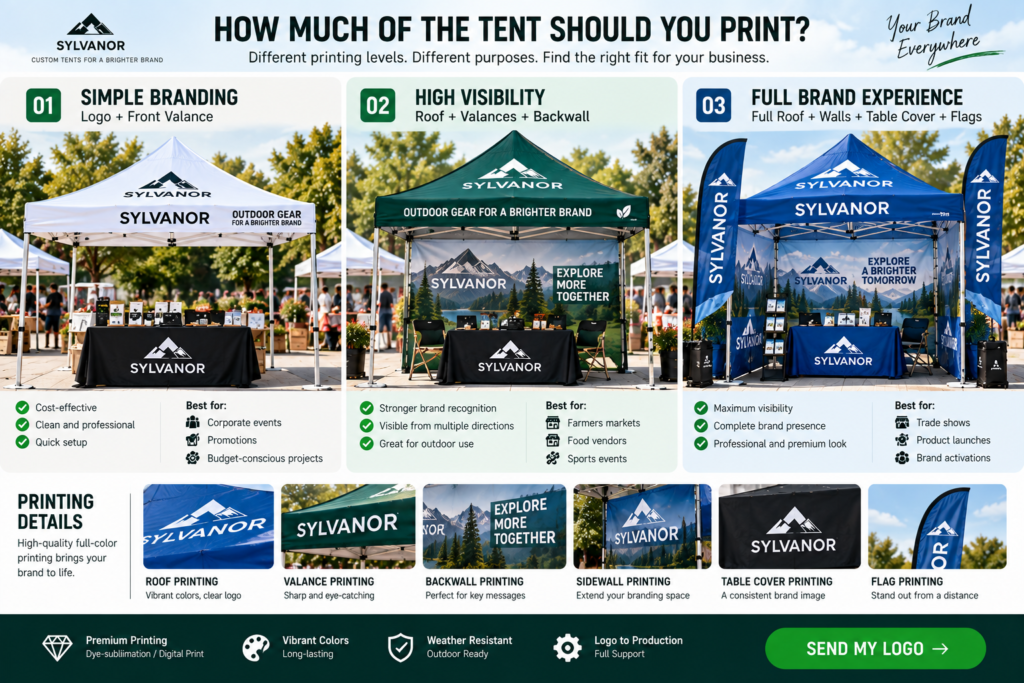
How Much of the Tent Should You Print?
More printing does not automatically mean better results. Think about how visitors will view your booth from different angles.
OPTION 01 — SIMPLE BRANDING
Logo + Front Valance
Best for:
- Corporate events
- Basic promotions
- Budget‑conscious projects
Goal: Clear brand identification without maximum print coverage.
OPTION 02 — HIGH VISIBILITY
Roof + Valances + Backwall
Best for:
- Farmers markets
- Food vendors
- Outdoor public events
- Sports events
Goal: Make your brand recognizable from multiple viewing angles.
OPTION 03 — FULL BRAND EXPERIENCE
Full Roof + Backwall + Sidewalls + Table Cover + Flags
Best for:
- Trade shows
- New product launches
- Large exhibitions
- Premium brand activations
Goal: Turn a 10×10 footprint into a fully immersive branded environment.
Full‑color dye‑sublimation printing is standard for modern commercial custom‑canopy systems.
Where Should You Put the Logo?
Do not fill every panel with graphics. Think about how customers approach your booth.
FRONT VALANCE
Use for: Brand Name / Short Promotional Message Keep text simple, readable from distance.
ROOF / PEAK
Use for: Large Logo / Brand Colors Avoid tiny hard‑to‑read text.
BACKWALL
Use for: Logo + Core Message + Product Imagery This is often the backdrop for booth photos.
SIDEWALL
Use for: Product highlights / Benefits / QR Code / Social Media Handles
TABLE COVER
Use for: Brand reinforcement at customer eye‑level
💡 DESIGN TIP: A tent does not need more information. It needs clearer information.
Already Have a Logo?
You do not need a finished tent design to reach out. You can start with just:
Logo + Application + Quantity
We will work out optimal printing coverage and full configuration together.
→ SEND MY LOGO
First Order? Don’t Over‑Customize Everything.
This is one of the most common sourcing mistakes.
New buyers often request: Custom Frame + Custom Fabric + Custom Color + Custom Carry Bag + Custom Carton + Custom Accessories + Multiple Artwork Versions
What happens next? 🔹 Higher MOQ 🔹 More complex inventory 🔹 Longer development timelines 🔹 Higher risk for your first order
A smarter market‑test configuration:
Existing Proven Frame + Verified Reliable Fabric + Custom Branding Only + Standard Off‑the‑Shelf Accessories + Simple Standard Packaging
You can add deeper OEM customization once you confirm market demand.
💡 FIRST‑ORDER TIP: Your first order should test market demand — not test how many custom parts a factory can produce.
Build Your 10×10 Canopy in 30 Seconds
You don’t need to master every technical spec. Answer these five simple questions.
STEP 1 — Where Will It Be Used?
□ Farmers Market □ Food Vendor □ Trade Show □ Sports Event □ Promotion □ Resale / Distribution
STEP 2 — How Often Will It Be Used?
□ Occasionally □ Monthly □ Weekly □ Professional / Rental Use
STEP 3 — How Much Branding Do You Need?
□ Logo Only □ Roof + Valance □ Full‑wrap Print □ Complete Branded Booth
STEP 4 — What Is Your Order Quantity?
□ Sample □ Small Batch □ Wholesale Bulk □ Long‑Term Repeat Program
STEP 5 — Which Target Market?
□ USA □ Europe □ Australia □ Other
Done.
Send these five answers together with your logo file.
→ GET MY 10X10 CONFIGURATION
What Actually Determines Your Price?
Once you know your ideal configuration, pricing becomes much clearer.
Your quotation is impacted by these factors:
SIZE 10×10 or alternative dimension ↓ QUANTITY Sample / Small Batch / Full Container Bulk ↓ FRAME Steel / Aluminum & exact spec grade ↓ FABRIC Base material & protective coating ↓ PRINTING Logo‑only / Partial / Full‑wrap coverage ↓ WALLS None / Backwall / Full Sidewalls ↓ ACCESSORIES Weights / Carry Bag / Flags / Table Cover ↓ PACKAGING Standard / Private‑label custom cartons ↓ DESTINATION Shipping & export requirements
Want a Useful Quote Instead of a Generic Price?
Send: Application + Quantity + Positioning + Artwork + Destination
→ GET PRICE & MOQ
Need a Lower MOQ? Simplify Your First Order.
MOQ cannot be judged in isolation. Always calculate:
MOQ × Unit Cost × Inventory Risk × Profit Margin × Future Reorder Potential
A simple configuration using existing factory frames with custom branding is much easier to launch. Full‑OEM development with dozens of custom components carries higher risk.
For your initial order, share two points with your supplier:
INITIAL ORDER
Realistic quantity you need right now
FUTURE VOLUME
What repeat‑order volume you expect if the product performs well
This creates a far more productive B2B conversation than only asking:
“What’s your lowest MOQ?”
From Logo to Shipment
Professional custom canopy projects follow a clear approval workflow to avoid costly mistakes.
01 — BRIEF
You provide: Application + Quantity + Target Market ↓
02 — CONFIGURE
We propose: Frame grade + Fabric + Full accessory list ↓
03 — DESIGN
We deliver: Logo mockup + Artwork + Printing proof ↓
04 — APPROVE
You confirm: Digital Proof / Physical Sample / Final Specification ↓
05 — PRODUCE
Production begins: Printing + Sewing + Frame assembly ↓
06 — INSPECT
QC checks: Product quality + Graphics accuracy + Packaging ↓
07 — SHIP
Export packing + Logistics coordination
Digital pre‑production proof approval is critical. Good manufacturers share mockups before printing starts.
💡 OEM TIP: Approve first. Produce second.
→ START MY OEM PROJECT
What You Can Verify Before Ordering
- Certifications available on request: Fire‑resistance (CPAI‑84 or equivalent), material test reports, export compliance documentation.
- Pre‑production approval rule: Bulk printing & production will NOT start without your written approval of artwork proof.
- Sample policy: Physical sample or pre‑production unit available based on your project scope.
- Spare‑parts support: Frame connectors, footplates and replacement components can be reserved for long‑term product programs.
Before You Pay the Balance, Check These 8 Things.
Save this pre‑shipment inspection checklist for your bulk orders.
□ 1. FRAME
Does frame open, close and lock smoothly?
□ 2. FABRIC
Does fabric match approved specification?
□ 3. LOGO
Is logo position and orientation correct?
□ 4. COLOR
Does print color match approved artwork / Pantone reference?
□ 5. WALLS
Do all panels and walls fit perfectly?
□ 6. ACCESSORIES
Are bags, weights, stakes and all parts fully included?
□ 7. PACKAGING
Are labels, barcodes, manuals and export cartons correct?
□ 8. QUANTITY
Final shipped quantity matches your purchase order?
💡 QC TIP: Your end‑customer receives one complete SKU, not separate frame and roof parts.
Which Buyer Are You?
Different buyer types should prioritize different specifications.
🥕 FARMERS MARKET BRAND
Top priorities: Portability + Branding + Easy Setup + Weights
Start With:
10×10 Commercial Canopy + Roof Branding + Backwall
🍔 FOOD VENDOR
Top priorities: Walls + Serving Window + Ventilation + Local Event Compliance
Start With:
10×10 Vendor Package
Always double‑check local event and fire‑safety requirements before locking final specs.
🏃 SPORTS / EVENT BRAND
Top priorities: Repeated Setup + Transport + High‑visibility Branding
Start With:
Commercial‑grade Frame + Full‑wrap Graphics
📣 MARKETING AGENCY
Top priorities: Visual Impact + Brand Consistency + Complete Display System
Start With:
Full‑Graphic Brand Activation Package
📦 DISTRIBUTOR / WHOLESALER
Top priorities: MOQ + Profit Margin + Packaging + Batch Consistency + Spare Parts
Start With:
OEM / Private‑Label Program
What Should Distributors Customize?
If you are building your own private‑label product line, work in four layers.
PRODUCT
Frame + Fabric + Size + Walls ↓
BRAND
Logo + Brand Colors + Custom Graphics ↓
PACKAGE
Carry Bag + Weights + Full Accessories ↓
PRIVATE LABEL
Custom Carton + Barcode + User Manual + Branded Labels
Your goal is to transform:
Generic Canopy into: Your Own Repeatable Commercial Canopy Program
This also protects you from pure price‑only comparison by end‑buyers.
When Should You Buy a Stock Tent Instead?
OEM customization is not always the best choice.
Stock ready‑made canopies make more sense when:
- You only need 1‑2 units
- You require fast local delivery
- Custom branding is not required
- Tents are for occasional, low‑frequency use
- Private‑label packaging is unnecessary
- You do not expect repeat orders
OEM sourcing becomes highly valuable when:
- You need custom branded graphics
- You are building your own product line
- You plan repeat bulk orders
- You require custom packaging
- You need unique configuration
- You are purchasing wholesale quantities
The real question is not:
Factory or retailer?
It is:
Do I need a one‑off tent — or a scalable repeatable product program?
Real Project: From Logo to Finished Canopy
[IMPORTANT: Replace this section with verified Sylvanor real‑world project data before publishing.]
CLIENT
[Real Customer Type]
MARKET
[Real Country / Region]
APPLICATION
[Farmers Market / Event / Trade Show / Food Vendor]
SIZE
[Verified Size]
QUANTITY
[Verified Quantity]
CUSTOMER NEEDED
[Real Project Requirements]
THE PROCESS
Logo ↓ Artwork ↓ Configuration ↓ Approval ↓ Production ↓ QC Inspection ↓ Packing ↓ Finished Product
FINAL CONFIGURATION
[Actual Frame Spec] [Actual Fabric Spec] [Actual Printing Scope] [Actual Walls & Panels] [Actual Accessories] [Actual Packaging]
Recommended Images:
Original Artwork → Design Proof → Production → QC Check → Finished Tent → Real‑world Customer Use
💡 Do NOT publish invented customer names, quantities or test metrics. Real evidence performs far better than fabricated numbers.
Why Work With Sylvanor on a Custom Canopy Project?
Your B2B canopy project does not have to start with a complex technical spec sheet. It can begin with five simple questions:
YOUR MARKET
Who will use this product? ↓
YOUR POSITIONING
Entry‑level / Commercial / Premium? ↓
YOUR CONFIGURATION
Which frame, fabric and accessories fit your goals? ↓
YOUR BRANDING
How should the product represent your brand? ↓
YOUR ORDER PLAN
Initial order volume + future reorder expectations?
Your goal is not to pick the highest‑end specs. It is to define a repeatable canopy configuration that fits your customers, target price point and business model.
→ DISCUSS MY PROJECT
Frequently Asked Questions About 10×10 Custom Pop Up Canopy Tents
How Much Does a 10×10 Custom Canopy Cost?
Pricing depends on frame grade, fabric quality, print coverage, walls, accessories, packaging and order quantity. For B2B wholesale sourcing, always compare quotes based on identical specifications, not just bottom‑line price.
Steel or Aluminum—Which Should I Choose?
Steel works well for cost‑sensitive, low‑frequency programs. Aluminum is better when low weight, frequent transport and repeated commercial setup are top priorities.
Is 600D Fabric Necessary?
Not always. Fabric selection should be based on application, coating, printing needs, performance requirements and target market — not just denier rating.
Can I Order a Sample First?
Physical samples or digital artwork proofs are available for most projects, to confirm branding and product details before mass production.
What Is the MOQ?
MOQ varies with customization depth. Existing frames with custom branding have lower MOQ, while full‑custom OEM development requires higher batch volumes.
Can I Send Only My Logo?
Yes. You can start by sharing: Logo + Application + Quantity + Destination We will finalize all remaining specifications in our project discussion.
Ready to Build Your 10×10 Custom Canopy?
You do not need full technical specs to get started. Send us these five points:
① APPLICATION
Farmers Market / Food Vendor / Event / Trade Show / Sports
② QUANTITY
Sample / Small Batch / Wholesale / Long‑Term Program
③ POSITIONING
Entry / Commercial / Premium
④ LOGO
AI / PDF / PNG / JPG file
⑤ DESTINATION
Country / City / Port